5 min read
What are absolute and relative risks?
Absolute and relative risks say something about the chance you have of a health problem. In nutrition science they are used to decide whether you are better off consuming certain foods or not. They are also calculated for medication, to estimate the gain of taking or not taking the medication.
Terms
Risk = Risk is the same as chance. We speak of risks because we are talking about the chance of health problems such as chronic (diabetes) or acute (heart attack) diseases. We also call this the ‘event’, in other words the occurrence in question (a person diagnosed with diabetes or with a heart attack). We often express chances/risks in percentages.
Population = A group of people with a specific characteristic.
Absolute risk = Absolute risk stands for how often an event occurs in a population.
Absolute risk reduction = Absolute risk reduction stands for a decrease in the absolute risk of the event.
Relative risk = Relative risk stands for how often an event occurs in a population in relation to another population.
Example: The state lottery
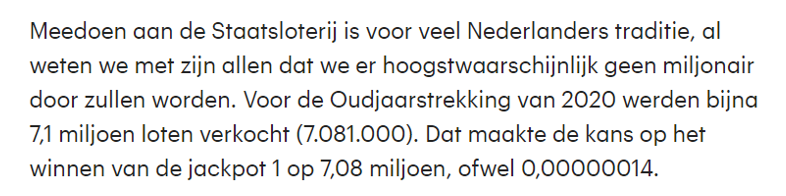
RTL nieuws shows the absolute risk (chance) here to tell people how small their chance is of winning the jackpot of the state lottery.
Population = people who did or did not buy a ticket (two different populations).
Absolute risk
You calculate the absolute risk by dividing the number of events (people who win the jackpot) by the number of people in the population (the number of people who buy a ticket) = 1 / 7,081,000 = 0.00000014 %*
*you always calculate percentages by multiplying the final number by 100.
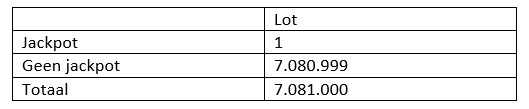
This means that you have a 0.00000014% chance (absolute risk) of winning the jackpot.
This also means directly that your chance (absolute risk) of not winning the jackpot is 100 % - 0.00000014% = 99.99999986%.
Relative risk
When you know the absolute risks within the population (people who bought a ticket), you can calculate the relative risk.
You calculate the relative risk by dividing the absolute risk of the event (winning the jackpot) by the absolute risk of not getting the event (not winning the jackpot).
Is this number smaller than 1? Then you get a negative percentage; if the number is above 1, you get a positive percentage. You then subtract the result from 1.
1 – (0.00000014 / 99.99999986) = 1 – 0.0000000014 = - 99.99999986%
Conclusion
When you buy a year-end ticket, you have a 0.00000014% chance (absolute risk) of winning the jackpot. You have a 99.99999986% chance (absolute risk) of not winning the jackpot. This means that your chance (relative risk) of winning the jackpot is -99.99999986% smaller compared to not winning the jackpot.
This is of course an absurd example. Your chance of the event is practically 0% and the chance of no event is practically 100%. This means that the relative risk is as good as -100%. Besides, when it comes to health problems, these chances (risks) would be music to your ears. However, now that you are buying a ticket precisely to win the jackpot, these chances are of course deeply sad.
Health
Let's now apply these principles of risk to a health problem: medication and heart attacks. There are a few important points to explain that you need to keep in mind:
-
We now have 2 groups (medication vs no medication) instead of 1 (bought a ticket).
-
Health problems build up over the years, so over time the chance piles up. for example: cardiovascular disease is caused by damage to the walls of blood vessels and hardening of the arteries. With an unhealthy lifestyle this builds up, so the risk of a heart attack keeps getting bigger. This does not apply to the state lottery: by buying a ticket every year, your chance of winning the jackpot does not go up every year.
-
Many more factors determine what your chance of a heart attack is, because multiple factors lead to damage and hardening of the arteries.
So what do absolute and relative risks look like for health problems?
Absolute vs relative risk
2000 people take part in a study. The people are divided over two groups: an intervention group (every day they take the medication*) and a control group (every day a placebo pill). These are the results after 4 years.
*you can replace this with whatever you like, for example eating vegetables, fruit or meat compared to not eating these things.

Absolute risks = 30/1000 = 3% 40/1000 = 4%
Absolute risk reduction = 4 – 3 = 1%
After 4 years your (absolute) risk of a heart attack is 3% if you take the medication every day and 4% if you do not take the medication. This is a decrease of 1% (absolute risk reduction).
Relative risk = 1 – (3 / 4) = 25%
This 1% absolute risk reduction is a relative risk decrease of 25%. Your risk of a heart attack is 25% lower when you take the medication compared to when you do not.
Important considerations
Then you might think ‘reporting only the relative risks is misleading, that is deliberately choosing the higher number!’.
There is a kernel of truth in this, but we do have to take certain factors into account when we interpret these risks:
(1) Your absolute risk is influenced by very many different risk factors and therefore differs per population and per person.
Unlike winning the jackpot (which depends on only 1 factor: buying a ticket), cardiovascular disease has very many different causes (risk factors: genes, gender, lifestyle etc.). Like most health problems. Together, these risk factors will determine how big your absolute risk of a heart attack is.
(2) Risks increase exponentially.
Unlike winning the jackpot (where your chance is reset every year), the risk of a health problem piles up on itself. The risk factors do damage to your body and the more this damage piles up, the bigger the chance becomes. As long as you do nothing about the risk factors, this builds up year after year (exponentially).
Example smoking versus not smoking
Let's look at smoking. Smoking damages the lungs. We also all agree that smoking is unhealthy and that smoking raises the risk of lung cancer enough not to do it (besides all the other damage it causes, of course). Let's look at how the risk develops for smoking versus not smoking:
At the age of 50 the absolute risk of lung cancer is about 1%, while non-smokers have an absolute risk of almost 0%. Then you might say ‘Hey! My absolute risk reduction is only 1%, I'm going to smoke.’ But if you look at the absolute risk at the age of 55, then your absolute risk is 5% and for smokers still about 0%, an absolute risk reduction of 5%. This even increases to 15% versus 2% after 30 years. How big your absolute risk actually is depends, besides person-dependent risk factors, on time (how long have you been smoking) and dose (how much do you smoke).
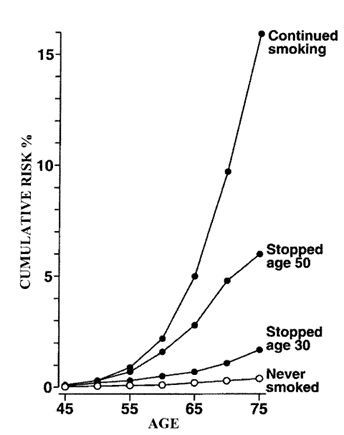
You can, however, look at the relative risks for smoking. The absolute risk reduction of not smoking versus smoking was about 1% at 5 years, but the relative risk is almost 100% (1% vs +/- 0%). This gives a good indication of how fast your absolute risk of lung cancer will rise if you smoke compared to when you do not smoke.
Conclusion
Both absolute and relative risks have their function and give an idea of your chance of a health problem.
Absolute risks give an idea of how big the chance actually is, but are very different per person because of a complicated web of risk factors, time and dose that all influence the absolute risk. If you look at absolute risks, you will have to look at the long term (years to decades). Our health is something that is determined over (decades of) years, not a few weeks, months or a couple of years.
Relative risks give an idea of the rise in risks relative to each other, which is less dependent on other risk factors and can also be compared better with other relative risks of other health problems.