
15 min read
What is nutrition science?
Nutrition science is the science that studies the physiological process of food, nutrients and all other (bioactive) substances in food and their effect on our health. It includes nutrition studies and all research that focuses on food (from complete dietary patterns to individual substances) and health. It brings together different fields such as physics, chemistry, biochemistry, biology, physiology, pathology and epidemiology.

Nutrition scientists study everything (and when) we eat and drink, and what effect that has on health. This can aim at both prevention and cure, and they want to describe, test and explain. We want to know what and when we can eat and drink to be as healthy as possible, but also what and when we can eat and drink when we are ill, to get healthy again. In nutrition science, researchers often look at individual nutrients, but more and more also at the food matrix or complete dietary patterns. To study the relationship between food and health, researchers use inferential statistics: on the basis of a sample (with the assumption that it is representative of the population), using statistics, making predictions about a population.
What is not nutrition science?
Now that we know what nutrition science is, it is just as important to discuss what is not nutrition science. To answer this question properly, it must be clear what science is. Science is a method, a system. At the macro level, this method is summarised in the Pyramid of Evidence and consists of different research methods, such as observational or experimental research. At the micro level, the scientific method prescribes a structure for writing and setting up individual studies. This usually comes down to the following parts: introduction (what is the background of the topic and what is the research question?), methods (how was the research carried out?), results (what are the results of the method that was set out beforehand?), discussion (what is the context for the results?) and conclusion (what is the answer to the research question?). The aim of the scientific method is to produce scientific evidence and to make clear how the evidence came about (which choices were made?), so that it is (as) objective (as possible), reproducible and verifiable. Objectivity, reproducibility and verifiability are important values within the scientific method, because scientists are people, and people quite often have trouble making objective choices. That is why the choices must be supported, transparent and verifiable. When the scientific method is not used, you do not speak of science or scientific evidence. So if we come back to the question of what is not nutrition science, we are talking, for example, about: a blog, a book, a YouTube video or a podcast about food and health. It does not matter who the author, speaker or interviewee is. So the fact that I studied health sciences does not make my blog science or scientific evidence. Not even when it is supported by all kinds of scientific literature – and that is a very important point: citing scientific literature does not make a blog (etc.) science or scientific evidence.
Why is nutrition science complex?
Despite the existence of the scientific method, nutrition science is not simple. The fact that nutrition science studies food makes nutrition science incredibly complex, because food consists of very many different food products and substances. For example, researchers estimate that there are between eight thousand and a hundred thousand plus metabolites present in humans and up to four hundred thousand in plants. But food is also full of nutrients and bioactive substances. All these substances have an effect on us and on each other. For some substances we know the effect of a deficiency or an excess on our health, and that it (often) only shows after years. For many other substances the effect is not yet clear.
Because research on food and health is so complex, many epidemiologists thought for a long time that it is almost impossible to study people's diets over longer periods. But in recent decades more and more methods have been developed and validated that make this possible after all. That is why more and more long-term studies are being carried out that follow people for years. From these, indications have emerged that various diseases, such as congenital abnormalities, most forms of cancer and cardiovascular diseases, are to a significant extent a result of what or when we eat and drink. Nevertheless, because of the complexity of food (and its relationship with other lifestyle-related factors), the association with our health is never simple. There is therefore still a lot of debate about the effect of different dietary patterns (and substances) on health. This is not strange in a science that is so complex and relatively young. For example, vitamins were only discovered about a hundred years ago, measuring instruments for substances such as metabolites are relatively new and genomics has also only taken off in the last few decades.
Difference between research on food and research on medication
The coherence of foods (and the many substances in them) that make up a dietary pattern, but also the relationship with other lifestyle factors, makes research on food and health unique. It is not as 'simple' as research on medication, where it is often about one specific, clearly defined substance. In addition, eating is something we do anyway, so food or nutrients are always in our system. This is also (usually) not the case with medication. Still, we use the same scientific methods (epidemiology) as the evidence for the effect of both food and medication. For example, randomised controlled trials (RCTs) are often cited as the gold standard of scientific research, but making a good design for this type of research for a food-related question is very complicated. When you want to study the effect of vitamin C, for example, you can give a group of people a vitamin C pill. You then compare this group with a group of people you do not give a vitamin C pill. However, people in both groups already have different amounts of vitamin C in their body. So you are not comparing two groups: something and nothing, but you are comparing two groups: different amounts less and different amounts more. How much less and how much more someone has in their system depends, for both groups, on the amount someone already had in their system (through their dietary pattern) and how much he or she is given. So you have to take into account how much vitamin C someone already has in their system and which other substances someone takes in that can have an effect on the absorption of vitamin C. Unlike with medication, then. But this is a very reductionist angle. Maybe we would rather know what the effect on our health is when we eat whole foods that contain a lot of vitamin C (such as a red pepper). But when you let one group eat a pepper and the other not, the pepper group usually eats it instead of something else – so is the effect then due to the pepper or to leaving out something else? Or does it come on top of the current dietary pattern, so that this group eats more than the other group? Or is the effect the result of other substances in the pepper, or precisely the combination of substances in the pepper? Tricky, then!
What is the criticism of nutrition science?
The complexity of nutrition science has been a fertile breeding ground for criticism. For example, Gary Taubes, an investigative journalist focused on science and health, published an article in Science as early as 1995 called 'Epidiomology faces its limits'. According to him, the epidemiology of nutrition science is mainly based on observational research and small RCTs that are completely influenced by confounding factors and distorted results (bias). In addition, according to him, the effects of food on our health (especially in the short term) are so small that they are almost impossible to measure, food intake also cannot be measured reliably, and our scientific methods are not suited to establishing causality between two factors. With, according to Gary, newspaper headlines (and now especially also blogs, books, YouTube videos and podcasts) with contradictory messages as the result. Many people therefore think that knowledge about food and health changes constantly, let alone that there is consensus. Which is not strange if you spend a lot of time on the internet. Journalists or other people who speak/write about food on the internet like to focus on the exciting headlines for as many clicks as possible instead of on the content. As a result, the nuances within scientific research are completely ignored. Large RCTs with a long follow-up would be the only solution to the problems mentioned above, according to Gary, but these would be practically infeasible and very expensive. Fortunately, a lot has changed since 1995. For example, nutrition scientists are more and more aware of the strengths and weaknesses of different instruments, methods, types of research and the limitations of reductionism. When you are aware of the limitations, as a scientist you can take these into account in the design of a study and include them in the interpretation of results for a conclusion. A lot of Gary's assumptions have therefore ultimately been refuted.
There is certainly a kernel of truth in the criticism. The points Gary raised must also always be kept in mind by readers of scientific literature and by scientists themselves. That is why I would like to see more nutrition scientists have their say, but unfortunately it is often other professionals who shout the loudest about food and health. For example, most books about food are written by doctors. The curriculum of a doctor contains hardly any teaching on nutrition, let alone nutrition science. You can therefore find a doctor who has written a book for every position (anti-carbohydrates, anti-fat, anti-plant-based food, anti-meat, anti-everything etc.). As a result, it seems as if there are very many contradictions within the scientific world of food and health, whereas this is not too bad. In my opinion, this is not so much the result of the limitations of nutrition science, but rather the result of a poor interpretation of the content of the literature or of ignoring the body of evidence as a whole. The fact that there seem to be so many contradictions, certainly for someone who spends a lot of time on the internet or Netflix for information about food and health, is no good reason to dismiss the whole of nutritional epidemiology. There is good, less good and poor quality (research or interpretation of) scientific research on food and health. Being able to recognise these is crucial for formulating a conclusion and for being able to judge what is good evidence with good strength of evidence for rejecting or not rejecting a hypothesis.
Is being critical necessary?
The complexity of nutrition science means that being critical of claims about food and health and the literature behind them is necessary! If any support is given at all, scientific literature is used left, right and centre to support claims about food and health. In addition, the food industry has certainly had influence on nutrition science over the past decades, so this too must be taken into account. That is why being able to judge the quality of a study, but also focusing on the whole body of evidence, is crucial. One swallow does not make a summer. In other words: one study is no study. Every study has its limitations, and without continuing to look critically at every study, and at the context in which the results must be placed, you cannot draw good conclusions. Many people (also researchers, experts or random YouTube people) use scientific literature to support his or her claim. But citing scientific research alone is not scientific evidence. You will have to check someone's sources (or gladly let me do that, of course). Does the literature even tell the same story as the person who interprets the literature? Does the study ask the same question? Does someone give the whole context? Does someone give insight into all the literature on the topic? You only know this by diving into the support and being able to judge and interpret the science.
What is Confirmation bias?
Often the answer is no. In my opinion, this is also where the biggest problem around food, health and science lies. People have preconceived ideas and beliefs about food and health (and often about everything that comes with health). Often the view of health also fits other beliefs they hold, and the people they listen to have the same beliefs. As a result, people end up in their own health bubble. Combine this with the natural tendency to mainly listen to and look at information that confirms our beliefs, and you have the biggest problem: confirmation bias. Confirmation bias is nothing less than that: mainly having an eye and ear for, and looking for, information that confirms your current beliefs. So when people use scientific literature to support their claim, picking cherries (cherry picking) often comes into play, by selectively using studies or results from studies to support their story. And then you have a reader/viewer who often no longer looks (critically) at the support, because the information matches their own beliefs, and then shares it with people with those same beliefs. A kind of confirmation bubble.
Fasting and health
So I walked into a piece in Bedrock with my eyes open, an online magazine for a conscious and healthy lifestyle. I do not remember exactly which article it was, but it was about intermittend fasting (periodic fasting). Something I was very busy with in my early years of Voeding en Diëtetiek (nutrition and dietetics), but for which there was not yet much scientific support at the time. The article was about the many health benefits of periodic fasting and the writer supported this with sources. But I never looked at the sources, because the story fitted my beliefs completely. So why look any further? I shared the article on my Facebook, after which an attentive friend responded that he had looked at the sources. And those sources were about completely different topics than periodic fasting. I will never forget it, because I was so disappointed in myself. How could I overlook that? How could I not look further than the end of my nose? But now I know exactly why: confirmation bias. (translated from Dutch)
The body of evidence and the Pyramid of Evidence
Gary Taubes was right in 1995: when you zoom in and compare different individual studies on food and health with each other, there are certainly contradictory messages. But if you do not zoom in far enough on the studies, you miss that there can be crucial problems in the quality of the study, that the research question is not the same as the conclusions people draw, or that the scientists have not done their work properly at all (maybe also because of confirmation bias). If you also do not zoom out far enough, you miss the context of the whole body of evidence. This results in contradictory messages, of which people choose the message that fits their own beliefs, and then proclaim it as the truth.
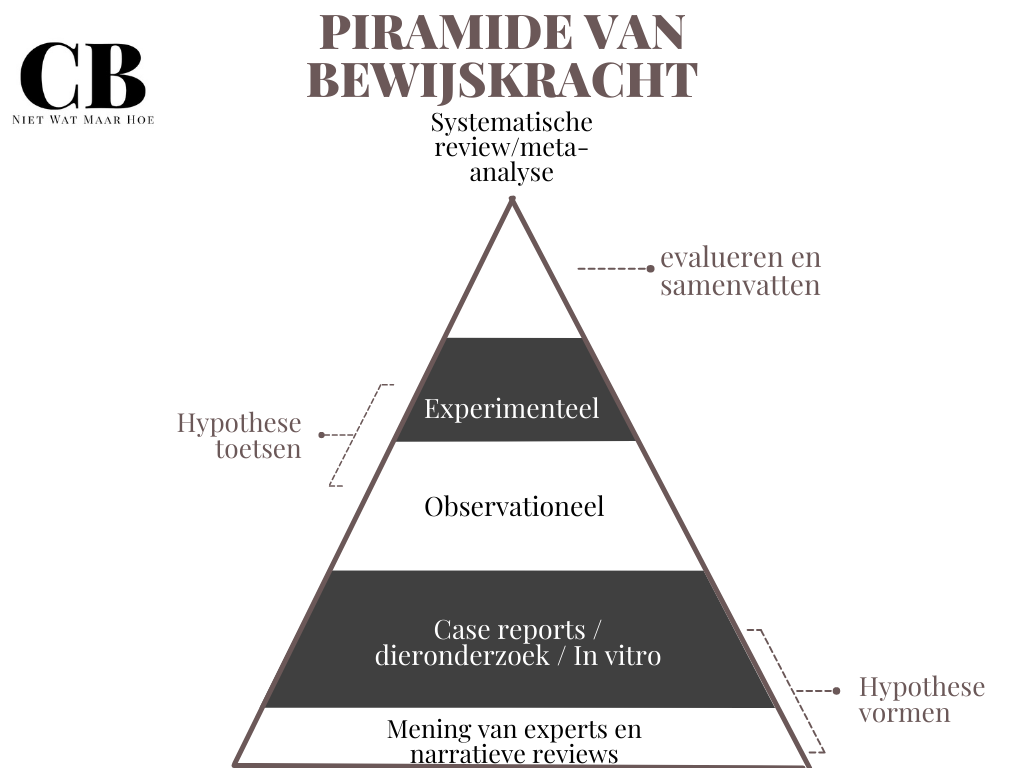
The body of evidence includes all the scientific literature (and so all types of scientific studies) on a specific topic and is often visualised in the Pyramid of Evidence (Pyramid of evidence). The Pyramid of Evidence consists of the hierarchy of different types of scientific research, ranked on the basis of the method behind the research. They are divided into different categories: expert opinions, case reports, in vitro, animal research, observational, experimental, systematic reviews and meta-analyses. These categories reflect the way in which the evidence came about, which in turn determines the strength of evidence it provides. However, the type of research in itself is no guarantee of good quality. Although this is often claimed. An observational study can be stronger in quality than a randomised controlled trial. Even though the latter is the 'gold standard', is higher in the pyramid and therefore provides better strength of evidence.
When we want to draw a conclusion about the effect of food on our health, the evidence from the different layers of the pyramid must be brought together into one story, in other words the body of evidence. Every type of research has its place in the evidence. For example, you can use research in animals or in vitro (laboratory) to demonstrate mechanisms and to formulate a theory (hypothesis). This hypothesis can then be tested in people living in the 'real' world by means of observation in observational research or in a controlled environment in experimental research. What kind of research it is, and therefore how much control there is over the environment and behaviour of the participants, determines how high the study stands on the ladder of the pyramid. Together with the quality of the study, this determines how strong the evidence is that is provided. So if you want to judge the evidence, you cannot only look at the pyramid, but you also have to look at the design of the study in terms of content and take all limitations plus context into account in your judgement. Various tools have been developed for this, which are used in systematic reviews to judge studies on quality. More about the Pyramid of Evidence and judging quality in article 2 of the 'What is'.
Where can you study nutrition sciences?
Have you read this article and become enthusiastic about nutrition science? Do you also find food, health and science so interesting and would you like to learn more about it? Are you stimulated by the complexity, or do you not want to take anything from anyone else and investigate for yourself? There are several studies you can follow to arm yourself better in the world of nutrition science. Nutrition science is a part of Gezondheidswetenschappen (Health Sciences). After a HBO or WO bachelor in healthcare, a WO research master is the perfect way to train yourself in both advanced science and nutrition.
| Programme (and where) | How long | Language | Admission requirements | Nutrition |
|---|---|---|---|---|
| Master Gezondheidswetenschappen (Vrije Universiteit Amsterdam) | 1 year full-time | English | Pre-master: HBO + 30 ECT in biology, physiology or biomedical Master: WO bachelor Gezondheidswetenschappen or the pre-master. |
The master has a specialisation: Nutrition and Health |
| Master Klinische Gezondheidswetenschappen (Universiteit Utrecht) | | | Pre-master: HBO focused on healthcare Master: WO bachelor focused on healthcare or the pre-master |
The Master consists of, among other things, a literature study and thesis of which you can choose the topic yourself (so also nutrition) |
What did you think of it? Let me know in the form of a comment or an email: [email protected]
Have you come across a claim on the internet or social media and are you curious about an assessment of the support for it, let me know and I will dive in!
Everything you read on this website is my opinion based on knowledge and experience. There is a good chance that I sometimes overlook something, or that something could be better. I would like to hear it! We do science together.
Terms
Food matrix: The concept of a food matrix shifts the focus from individual substances to the whole and the coherence of all substances in a food. This goes much further than a sum of the carbohydrates, fats, proteins, vitamins and minerals. It includes all (bioactive) substances that you find within the structure of a food. Back to where you were.
Inferential statistics: Drawing conclusions on the basis of assumptions. An important assumption is that the sample (the participants of the study) is representative of the population (from which the sample was drawn) about which conclusions are drawn. Back to where you were.
Reproducible: Reproducibility of a study is about the possibility of repeating the study on another sample to confirm or refute the results. Back to where you were.
Metabolites: A metabolite is an intermediate or end product that arises in our metabolism (stofwisseling). You can think of amino acids (building blocks of proteins), ATP (the end product that gives energy to our body) or ethanol (an alcohol that arises during fermentation of carbohydrates). Back to where you were.
Nutrients: Nutrients includes all substances in food that the body needs to live. This is, for example, about macronutrients such as proteins, fats and carbohydrates, but also all vitamins and minerals. Back to where you were.
Bioactive substances: Bioactive substances includes all substances that give a biological or physiological response in our body. They are not essential for the body, but can probably contribute to optimising processes in the body. Examples of bioactive substances are caffeine, creatine, taurine or prebiotics. Back to where you were.
Epidemiology: Epidemiology stands for the scientific methods used for research on health and disease. The topic of interest is therefore always focused on something to do with health or disease. Back to where you were.
Validation: The validity of a measuring instrument says something about the correctness of a measurement. Do you measure what you want to measure. If so, with repeated measurements you will always get closer to reality. However, the more unreliable the measuring instrument, the more often you have to repeat the measurement to get closer to reality on average. Validity is an important requirement for measuring instruments, since the data from the measuring instruments are crucial for research. If the instrument does not measure the right thing, the results are based on untruths. A good way to examine the validity of an instrument is to compare it with a gold standard. The gold standard is a measuring instrument of which we are sure that it makes the right measurements. If the instrument scores (almost) as well as the gold standard, the instrument is valid. Back to where you were.
Genomics: Genomics is the study of genomes in relation to the cause and course of disease, medication, food and much more. A genome is a group of genes of a cell or organism. Back to where you were.
Randomised controlled trials (RCTs): Randomised controlled studies are experimental in nature. This means that the researchers divide the participants into groups: the intervention group and the placebo/control group. Participants in the intervention group receive the intervention, for example a supplement or diet, and the control group does nothing or receives a placebo. More about RCTs in the 'what is' series (link). Back to where you were.
Reductionism: A scientific movement in which everything is reduced to the smallest little substances. The individual little substances are then studied in relation to our health. Back to where you were.
Confouding: A confounder is a (third) factor that causes a distortion of a relationship between two other factors. It gives a wrong impression. For example, it can make it seem as if there is an association or precisely not. A confounder has a relationship with both the explanatory factor (determinant) and the outcome, but is not on the causal path. By including confounders in a statistical analysis, the direct association between an explanatory factor and outcome can still be studied. Back to where you were.
Bias: Bias stands for a distortion of the results. In other words: the results are different from what they really are. Distortion is a difficult concept that can occur in all kinds of forms. For example, it can be in the interpretation of the results because the person interpreting does not look at the results objectively due to prejudices (confirmation bias). But distortion can also occur through the design of a study. For example when the sample is not representative of the population (selection bias) or when the people studied have to provide information on the basis of their memory (recall bias). Back to where you were.
Causality: When a factor is the direct cause of another factor, we call that a causal link. Back to where you were.
Follow-up: When in a scientific study there are multiple measurement moments over time (for example after one month and after two months), we call that follow-up measurements. This way it can be examined whether a factor changes over time. Back to where you were.
Body of evidence: All the results of all (types of) studies on a certain topic together. When we want to draw a conclusion about the effect of food on our health, the evidence from all categories of the Pyramid of Evidence must be brought together into one story. In other words the body of evidence. Back to where you were.
Picking cherries (cherry picking): When studies or results of studies are chosen selectively and subjectively to support a claim, we speak of picking cherries (cherry picking). Back to where you were.
Periodic fasting (intermittend fasting): When a part of a day or week is deliberately chosen in which nothing is eaten or drunk (except water), we speak of periodic fasting.