
15 min read
Vegetable oils or vegetable-malignant oils? (part 3)
Vegetable oils are unhealthy. Various dietitians, nutrition experts, scientists and investigative journalists are convinced of this. They mainly mean refined vegetable oils that are high in omega-6 fatty acids. These oils are said to contain dangerous chemicals, disturb our fatty acid balance and be prone to oxidation. This is often claimed without any questions asked, but sometimes scientific research is cited too. Anyone who digs into the scientific literature behind the dangers of vegetable oils gets tangled up in a web of reviews with nice stories about mechanisms and clinical studies. How strong is the scientific support for the dangers of vegetable oils? Are vegetable oils actually vegetable-malignant oils?

In part 1 and part 2 I covered the scientific literature behind several theories about the relationship between vegetable oils and cardiovascular disease, overweight and lifespan. Because of too high an intake of omega-6 fatty acids (linoleic acid), we would make our cells prone to oxidation, which raises the risk of cardiovascular disease and death. During the first 1000 days, that same too high intake of omega-6 fatty acids would programme a child's body for overweight later in life. So far, all the theories turned out to be mainly hypotheses based on poor science, studies with animals and correlations. What if the harmful effects of vegetable oils are not necessarily down to a too high intake of omega-6 fatty acids, but to the harmful substances that are released when omega-6 fatty acids oxidise, for example during heating in the deep fryer or in the body? Strong correlations and mechanisms have indeed been found for the relationship between aldehydes (oxidation products) and various (lifestyle-related) chronic diseases such as dementia, Parkinson's, diabetes, cancer, inflammatory diseases, cardiovascular disease and many more. Aldehydes arise during the oxidation process and, as I explained in part 1, polyunsaturated fatty acids, such as omega-6, are prone to oxidation. In his video, Joseph cites several studies that have investigated this danger. Let's dive into the science.
“When fats oxidize (when they are heeted), they produce oxidation products that give the fat a bad flavor and these oxidation products are also toxic… Now the other thing about the fragile polyunsaturated omega-6 linoleic acids in vegetable oils, is they’re still problematic even if not heated. Heat isn’t the only way to oxidize vegetable oils. They can just oxidize sitting on the shelf… vegetable oils also oxidize while sitting in your body, creating toxic oxidation products like an aldehyde called 4-HNE. 4-HNE is in fact considered to be the most toxic aldehyde and this compound has been associated with aging, heart disease, diabetes and alzheimer’s.” – the $100 billion dollar ingredient making your food toxic
How much linoleic acid do we eat?
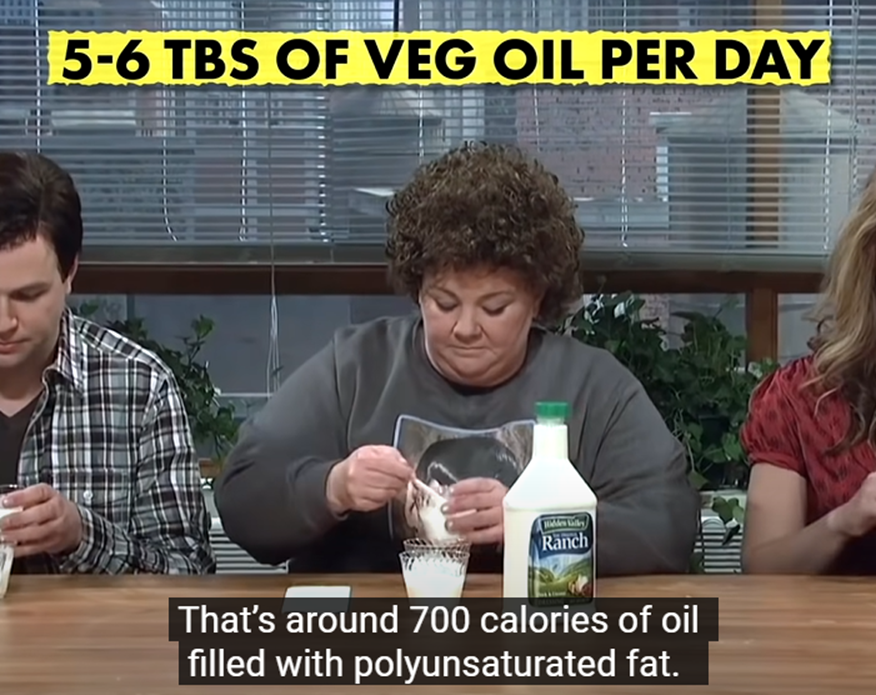
Before we dive into the science, I first want to touch on something: how much linoleic acid do we actually eat? Joseph also goes into this before he makes the claim that I am about to cover. According to him, Americans eat some 5 to 6 tablespoons of vegetable oil a day, which equals 700 kcal. Think about that for a moment: that is really gigantic. Maybe a third of what an average person needs in energy. However, he does not name a source when he claims this.
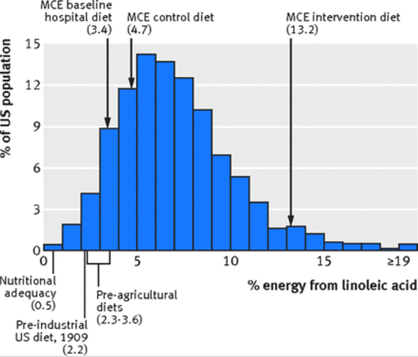
When I was going through a study by Ramsen et al. (I covered his research in part 1), it turned out that Ramsen also dealt with these questions. The study looked at the average intake of linoleic acid (the omega-6 fatty acid in vegetable oils) in America. Ramsen states that an average American gets some 17 grams per day (7% of total energy intake) of linoleic acid. For comparison: in the Netherlands it is estimated at 14 grams per day. 17 grams is about 153 kcal… So I have no idea what Joseph bases those 700 kcal on. I understand that not all vegetable oils are pure linoleic acid, but his video (and a lot of the evidence) is mainly about oils rich in linoleic acid. So it seems as if he exaggerates a bit how much vegetable oil people actually consume.
My own bias
I fry in olive oil myself. I would recommend that to everyone, too. Of all the theories I have covered so far, this one seems the most plausible to me. Heating easily oxidising oils for a long time or several times seems like a bad idea to me: food from the deep fryer is bad for you (surprise!).
Claim: When vegetable oils oxidise (which happens during frying/deep frying and in our body), substances such as aldehydes are released that are toxic and therefore bad for our health. They are so harmful that they are the underlying cause of almost all the lifestyle-related diseases we know.
Source: Schoeb, M. Et al. (2014) 4-Hydroxynonenal in the pathogenesis and progression of human diseases.
The first study that is cited is a narrative review by Shoeb et al. They carried out a review to investigate the role of 4-Hydroxy 2-nonenal (HNE) in various disease processes and how regulating the metabolism of this aldehyde could be used therapeutically. HNE is, according to Shoeb, one of the most toxic aldehydes of all of those that arise during the oxidation of omega-6 fatty acids. It would be an important marker of oxidative stress, a possible cause of various diseases such as Alzheimer's and a stimulus of inflammation in the body.
“One of the most abundant and cytotoxic lipid -derived aldehyde is 4-hydroxy 2-nonenal (HNE). The HNE is formed by the oxidation of ω-6 polyunsaturated fatty acids. During autoxidation, fatty acids form alkoxyl radicals that undergo beta-scission leading to the formation of several saturated and unsaturated oxo-compounds of which HNE is one of the most reactive and under some conditions represents 95 % of the generated aldehydes. Currently, HNE is considered an important marker of oxidative stress, a possible contributory agent to several diseases such as Alzheimer and a stimulant of prominent pathobiochemical pathways such as inflammation, indicating a potential contribution of the aldehyde to the pathogenesis of several chronic diseases.”
The author concludes that HNE undoubtedly plays a role as a "toxic messenger" of oxidative stress. An increased production of HNE is seen in various diseases in humans. HNE can namely disturb the stability of cells, resulting in cell death – and when cells die, we get ill or we die.
If we dive deeper into the results, there are certainly a few caveats that need to be made. The caveats are made by Shoeb et al. themselves.
Firstly, HNE is not always toxic, the opposite is even true. When you watch Joseph's video, HNE is presented as a toxic substance that is associated with a gigantic list of serious chronic diseases. This is nice storytelling. However, the truth is (as always) more nuanced. According to Shoeb et al., the concentration of HNE in the cells is important. Lower concentrations (< 2 µm) have a health-promoting effect, yes, you read that right, it can be healthy. It is only at a higher concentration of 5 µM to 5 mM or more that HNE becomes toxic and can lead to dysfunction of mitochondria (energy factories), DNA and proteins in the cell. (µM stands for micromolar. 1 µM is equal to 0.001 millimolar)
“4-HNE exerts physiologically beneficial effects depending on its intracellular concentration. Lower intracellular concentrations (< 2 µm) of 4-HNE seems to be beneficial to cells as they promote cell survival and proliferation… Steady-state concentration of 4-HNE can easily reach 5 µm to 5 mM or more within membranes during various pathological conditions. 4-HNE has been shown to have high toxicity to mammalian cells, can inactivate various enzymes and also inhibit DNA and protein synthesis”
Secondly, the metabolism of HNE is not fully understood at all. Glutathione would play an important role in the metabolism of 4-HNE. Glutathione is an important antioxidant that occurs in plants, animals, fungi and bacteria and helps to protect the body against oxidation and harmful substances. We too have a high concentration of glutathione in our cells. According to the authors, research has already shown that glutathione can help prevent diseases such as Alzheimer's.
“A number of antioxidants including glutathione that alter the intracellular concentrations of HNE have been shown to prevent Alzheimer and parkison…. HNE has been shown to alter the cellular redox homeostasis responsible for cell growth, death and differentiation. Further, recent studies indicate that glutathiolation of HNE regulates its toxic effects. Despite multiple studies showing the connection between oxidative stress-generated lipid aldehydes (specifically HNE) and pathological consequences leading to a number of disease processes, the mechanisms by which varying concentrations of HNE detects cells fate towards death or growth is not clearly known.”
Even though Joseph is fully convinced of the dangers of HNE, it is thus not at all clear to Shoeb et al. yet what the role is of the oxidation of omega-6, HNE metabolism and our health. Maybe the second study that he cites will bring some clarification.
Vegetable oils, HNE and our health
He cites Yamashima as an expert in the field of vegetable oils, HNE and our health.
“Neuroscientist Testumorio Yamashima has done plenty of research on vegetable oils and 4-HNE. He’s published multiple papers on the damaging effects of this compound and why people need to avoid vegetable oils because they oxidize into 4-HNE in our bodies.” – the $100 billion dollar ingredient making your food toxic
Yamashima carried out a narrative review to investigate the role of oxidation products, which arise when vegetable oils are heated, in cell degeneration, cell death and the occurrence of various lifestyle-related diseases. This concerns oils of soy, rapeseed, sunflower or corn that are rich in linoleic acid (omega-6 fatty acid). He distinguishes between exogenous HNE, which arises during oxidation outside our body (for example during frying), and endogenous HNE, which arises when our cell membranes or LDL particles oxidise. Endogenous thus refers to the Polyunsaturated Fatty Acid Oxidation (MOVO) hypothesis that I discussed earlier in parts 1 and 2.
“Surprisingly, a lipid peroxidation product known as hydroxynonenal is generated during deep-frying of vegetable oils made from rapeseed, soybean, and sunflower that contain abundant linoleic acid. Further, even after incorporation into the body, reactive oxygen species attack ω-6 PUFAs in the membrane phospholipids to generate endogenous hydroxynonenal”
The author concludes that it is reasonable to state that HNE, arising from the oxidation of omega-6-rich vegetable oils, is the cause of cell degeneration, cell death and diseases such as Alzheimer's and other lifestyle-related diseases.
If we dive deeper into the results of the narrative review, there are certainly a few findings that I want to share with you.
“Exogenous hydroxynonenal is generated from ω-6 PUFAs, especially linoleic acid, during deep-frying of vegetable oils made from rapeseed (canola), soybean, sunflower, corn, etc.(77)”
Firstly, Yamashima provides no evidence for the claim that HNE arises during deep frying with vegetable oils. He claims that exogenous HNE is formed during deep frying with vegetable oils of rapeseed, soy, sunflower, corn etc. that are rich in linoleic acid (omega-6). However, in the source (source 77) that he cites for the claim, deep frying with vegetable oils is not mentioned anywhere in the study. The study is very technical and cites many points that Yamashima (and Shoeb et al.) also cite. However, the formation of HNE during the heating of vegetable oils is not discussed. The authors do state that the effect of HNE on our health depends entirely on the HNE concentration, duration of exposure and type of cell. Low concentrations promote health, and getting enough antioxidants (such as vitamins C, E and A) can counter the danger of a too high HNE concentration. Finally, the authors give a recommendation for growing old as healthily as possible: reduce oxidative stress by avoiding an energy-rich diet high in fat and carbohydrates.
“To extend lifespan, a decrease in oxidative stress is recommended, by improving ROS and LPO sensing and maximizing the cellular antioxidant defenses. High-calorie diets (high fat and high carbohydrates) are linked to a high oxidant status in the organism, and recommended calorie restriction involves a decrease in total caloric intake while maintaining adequate nutrition, to extend the lifespan or improve health.” – bron 77 Dalleau et al.
Mcdonalds breakfast and HNE
Secondly, I have question marks/caveats about the evidence that Yamashima provides for his claim that a fast food meal (McDonalds) raises concentrations of HNE. He claims that consuming fast food deep-fried in vegetable oils causes a significant rise in HNE concentrations within minutes to hours after the meal. He cites a randomised controlled cross-over study (source 78) in which 11 people with metabolic syndrome were given either a McDonalds meal (FFS: burger, fries and soft drink) or a meal following the guidelines of the American Heart Association (AHA: bagel, cheese, fruit and milk) as breakfast. Their blood was then drawn at baseline and after 2, 4, 6 and 8 hours (in those 8 hours the participants ate or drank nothing except water).
“After consumption of high-fat “fast food” cooked with such ω-6 PUFA-rich vegetable oils, the concentration of hydroxynonenal in the plasma increases significantly and rapidly; within minutes to hours”
I will briefly list my caveats/question marks:
(1) According to Yamashima the HNE already rises within minutes, but the first measurement after the meal was 2 hours later. So what does he base that on?
(2) According to Yamashima the McDonalds breakfast is deep-fried in vegetable oils, but the study says that there were no unsaturated fatty acids at all in the meal… There is a gap in the macronutrients of 35.5 grams of fat (51 grams of fat in total and 15.5 grams of saturated fat, 0 grams of unsaturated fat) and this could just as well be the unsaturated fatty acids. This is just not mentioned anywhere in the study. Strange.
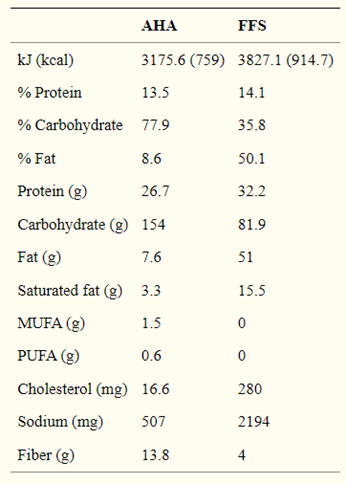
(3) The McDonalds breakfast causes an increase from an average of 1.3 (baseline) to 2.1 µm MDA (another aldehyde) and HNE. Yamashima speaks of a rise in HNE, but he does not know this at all. We cannot conclude from this how large the rise in HNE is, because it is not clear what the ratio between MDA and HNE is. In addition, the McDonalds group has a considerably higher MDA and HNE concentration in the blood at baseline than the AHA group, but it is not clear why. We learned earlier that the level of the concentration is very important, an HNE of below 2 µm is still health-promoting. Had the McDonalds group also started at 0.8 on average, they might never have touched the 2. This is of course speculating.

What is clear is that the McDonalds meal is not healthy! There was a significantly worse score on virtually all biomarkers of oxidative stress and inflammation compared with the AHA breakfast. The study also shows that the rise in MDA and HNE continues for a very long time, up to 8 hours after eating the meal. Even though the participants ate nothing else. So you can imagine that if you were to eat three unhealthy (deep-fried) meals over the day. This can certainly cause a chronic elevation of aldehydes in the blood. But again: how large the rise in HNE was, we do not know.
The authors of the study conclude that the McDonalds meal does worse because of the high fat, energy and salt content of the meal. This emphasises an important point: we do not know how much HNE was actually in the meal (this was never measured). We also do not know exactly what the rise is due to. Is the rise in MDA and HNE the result of the high energy, fat, salt or oxidised frying fat content? We cannot conclude that from this study. Yamashima cannot either, even though he is very firm in his interpretations of this study. All we know is that McDonalds is less healthy than a breakfast following the guidelines of the AHA -- and that is of course no surprise.
Frying fat and oxidation
Only now I am left with the question: what about that frying fat? The meal in the McDonalds study had almost no unsaturated fatty acids in the meal, so would it have been deep-fried in saturated fat? Then the study goes completely against Yamashima's point. I went looking in the McDonalds study and, to my surprise, came across a study in which participants had to consume used frying fat. You read that right. Participants were given either a low-fat meal or a meal enriched with frying fat that had not been used yet or a meal enriched with frying fat (from a fast food restaurant) that had been used for a week. The researchers only saw impaired blood vessel function (an indication of oxidative stress) in the used frying fat group. Only when we then look at the frying fat, we see that it was mainly saturated fat and not unsaturated fat.
“The composition of the high fat meals (used and unused fat) was: energy (3,754 kJ), fat (64.4 g), saturated fat (30 g), polyunsaturated fat (4 g), carbohydrate (62.5 g) and protein (20.5 g). The composition of the low fat meal was: energy (2,022 kJ), fat (18.4 g), saturated fat (8 g), polyunsaturated fat (2 g), carbohydrate (62.5 g) and protein (20.5 g).” - bron 78 Devaraj et al.
The authors conclude that heating oil in a deep fryer certainly causes oxidation products that have a negative impact on our health. So you could say that when deep frying is done in unsaturated fats (which are even more prone to oxidation), even more oxidation products such as HNE arise. However, this too is speculating. I do want to make it clear that in his video Joseph argues for going back to deep frying in saturated fat (because it would not oxidise), but this study shows that this is not necessarily better for health. Do you want to eat healthily? Do not eat deep-fried food. Surprise...
Guideline for linoleic acid intake
“Too much ω-6 PUFAs shifts normal physiological function to pathophysiological, thereby causing harm in a dose-response manner. Excessive ω-6 PUFA” intake can be described as merely above 0.4% of food energy (0.4 en%)."
Finally, Yamashima gives a concrete guideline for a too high linoleic acid (omega-6 fatty acid) intake, but consciously or unconsciously leaves out the context. Yamashima claims that a linoleic acid intake above 0.4en% is already a risk factor for lifestyle-related diseases such as Alzheimer's, cardiovascular disease, diabetes and obesity. If we then look at the 17 grams (7en%) of linoleic acid that is consumed per day in America, that is many times higher. He bases this on a narrative review (source 179) that focuses on the ratio between omega-6 and omega-3 fatty acids, not omega-6 in itself. The study claims that a 0.4en% linoleic acid intake can raise the risk of cardiovascular disease when the intake of omega-3 fatty acids is too low – and that is an important caveat. It is relative. Important context if you ask me.
"People with more than 50% n-6 in HUFA have a greater risk of death from cardiovascular disease (CVD) than people with less than 50% n-6 in HUFA…. In the absence of dietary n-3 nutrients, intakes of n-6 linoleic acid as low as 0.4 percent of food energy (0.4 en%) can give 50% n-6 in HUFA.” - bron 179 Clark & Lands
Clark & Lands base this in turn on another narrative review (by the same author). It is a kind of narrative reviewception, a review in a review in a review, which creates a web of narrative reviews that is almost impossible to check all of for accuracy. Still, I could not resist taking a small dive. To my surprise, the third-level source (1 yamashima > 2 Clark & lands > 3 Lands) says that an intake of up to 2en% linoleic acid brings no risks with it… I could not find any further source on which the review bases this, but it contradicts what Yamashima claims: that everything above 0.4 en% has harmful effects.
“Recommended Dietary Allowance (RDA) near 0.5 en% meeting needs of 97–98 percent of individuals, and a Tolerable Upper Intake Level (UL) near 2 en% having no likely risk of adverse health effects.” - Lands
The conclusion
I cannot look at another narrative review. I am just afraid that these will not be the last ones.
It is clear that, as always, more context and nuance are needed than is given in Joseph's video. 4-Hydroxy 2-nonenal (HNE) is an aldehyde that most likely plays a role in various diseases of affluence, but HNE is not toxic in itself. We need a low concentration in our cells, and it only becomes dangerous at very high concentrations. The metabolism of HNE is still not fully understood. Food can both raise HNE concentration (through a MCDonalds breakfast) and lower it (antioxidants). This context is given by Shoeb et al., but it is left out by Joseph.
Yamashima, as an expert in the field of HNE, has written a gigantic narrative review. When I looked at the more practical points (does heating oils more raise HNE concentrations? How much linoleic acid in our diet is still healthy?) there turned out to be poor science (poor referencing or interpretation of sources). It is clear that you should not drink frying fat or eat deep-fried food. But a lot is also still unclear: what if you eat a lot of antioxidant-rich food with your deep-fried meal? How much HNE arises when vegetable oils are heated? And what impact does that have on concentrations in cells?
How strong is the evidence for the claim: when oxidising (which happens during heating/deep frying and in our body), substances are released that are toxic, such as aldehydes, which are bad for our health. They are so harmful that they are possibly the underlying cause of all the lifestyle-related diseases of affluence that we know?
Joseph cites two narrative reviews. As far as I am concerned these are no more than opinions of experts (at the bottom of the Pyramid of Evidence), which have to be judged on the (quality of the) evidence they provide for their claims. Shoeb et al. left room for uncertainty and gave a lot of context to the dangers of HNE with proper referencing, which strengthens the quality and thereby the strength of the evidence. Yamashima wrote a gigantic review with some 180 sources. You can never check all of these. From the sources that I checked, it turned out that Yamashima cites sources that do not support his claim or are interpreted wrongly. This is done unconsciously or consciously to support his own claim, which makes me doubt the scientific accuracy of the rest of the review. The quality and thus the strength of the evidence is therefore low.
What did you think? Let me know in the form of a comment or an email: [email protected]
Have you come across a claim on the internet or social media and are you curious about an assessment of the support for it, let me know and I will dive into it!
Do you want to support me and my nutrition science adventure? Share my articles or the podcast on your socials!
Everything you read on this website is my opinion based on knowledge and experience. There is a good chance that I sometimes overlook something, or that something could be better. I would love to hear it! We do science together.
Terms
Correlations: The association between two factors. Back to where you were.
Metabolism: Metabolism, also known as substance exchange, stands for all the chemical reactions in the body that provide energy and all the substances (such as metabolites) that are needed to make the body function. Back to where you were.
Metabolic syndrome: Metabolic syndrome is a collection of complaints around metabolism. It concerns a combination of raised cholesterol, high blood pressure, overweight (especially an increase around the belly) and a high blood sugar level. Back to where you were.
Significance: (Statistical) significance, also called the P(robability)-value, stands for the probability that the result found was found while the null hypothesis (there is no effect or difference) cannot be rejected. In other words, significance stands for the probability that the result found is based on chance and when this probability is small enough the null hypothesis can be rejected and the alternative hypothesis accepted. Back to where you were.