
49 min read
“Our tap water is unhealthy!”
Our tap water is known worldwide for its top quality. On average we use 118 litres of it a day, and our drinking water treatment plants are among the most efficient in the world. We also win prizes, such as second prize for tastiest tap water in Europe. But my bubble burst when I was told that more and more people doubt our tap water: is it really that healthy? Together with companies that sell water filters, they claim that our tap water still contains a lot of chemical junk that causes health problems in the long term. So I became curious: what is the science behind our tap water? Is our tap water unhealthy?
Let me start at the beginning. A few months ago I was pointed to an Instagram post by Richard de Leth. He recommends that everyone buys a water filter costing more than 300 euros (Aquatru) and installs it in the kitchen. Since then I have also found out that a water filter is recommended in (some) training programmes for orthomolecular therapists. Apparently our tap water is not as healthy as we always thought. For him this was old news. For me a whole new world opened up. And when someone tells me something that goes completely against my current beliefs, you have my attention. I decided to dive into the science behind water filters and our tap water -- a dive that has become the deepest dive so far.
My own bias
As I said, I am convinced that our tap water is healthy. I also drink at least 2 litres of it a day, without a filter. Still, I realise that we are polluting the world around us quite badly, and with that probably our drinking water too.
Disclaimer: I am not a toxicologist! What you are about to read is a summary of my dive into the literature behind the safety standards for our tap water. If I got something wrong, let me know! These are completely new waters for me. I dived into the European regulation on the production of and trade in chemical substances, called REACH (REACH: registration, evaluation, authorisation and restriction of chemicals), and into the related documents of the WHO, the EFSA, the Gezondheidsraad and the RIVM about drinking water quality. These are gigantic documents that cost me many hours. I skip parts and summarise everything so that this does not become a document of 20,000+ words (I had first written 10,000, but that was not going to work) and so that it is still somewhat understandable for you. I would like to thank Food Claims Centre Venlo for their help with this dive. I also had contact with both the ECHA and the ILT about questions I had.
Tap water is unhealthy
Behind Richard's post about the water filter Aquatru there is a blog: Is ons kraanwater gezond? (helaas niet) (Is our tap water healthy? (unfortunately not)). A blog that is already four years old, so apparently this idea is nothing new. Two claims come up in this blog, and I deal with both of them:
-
The sources of our tap water (surface water and groundwater) are heavily polluted.
-
The safety standards for our drinking water are not enough to consider our tap water healthy.
First I dived into the quality of the sources of our tap water: the surface water and groundwater in the Netherlands. I made a reel about this on Instagram. It turns out Richard is completely right. The quality of our sources is dire. The ecological consequences of our densely populated country, intensive agriculture (with the use of pesticides) and the use of medicines are disastrous. Life in the surface waters suffers daily from all the junk we put into the water, and the groundwater is being polluted to ever greater depths: groundwater ageing (grondwatervergrijzing).
But fortunately we have gigantic treatment plants, strict legislation and drinking water companies that carry out checks to safeguard the quality of our drinking water. Still, according to Richard and Aquatru, this is not enough.
Richard
“Water treatment companies are not able to filter all chemical substances out of our drinking water. This means that our tap water still contains small amounts of medicines, pesticides, cosmetics, flame retardants and nanoparticles. And the long-term effects of daily exposure to medicine residues in our drinking water are unknown.” (translated from Dutch)
“That is why the government has set drinking water standards. These state the maximum permitted amount of certain substances in our drinking water. Within these standards our water is considered safe. This means that we do not get ill from it directly in the short term. But we certainly do not get any better from it. In the short term, many of these substances make us feel worse, even in small amounts. Think of a worse memory.” (translated from Dutch)
Since Richard does not cite any scientific literature, I dived into the scientific literature that Aquatru cites on their website. There they claim that the substances, such as aluminium and arsenic, that are (or can be) in our tap water (and the concentrations of them) are harmful to our health. In a reel I showed that 1. Aquatru cites no scientific evidence anywhere for negative health effects of drinking tap water and 2. they cite no evidence showing that, for example, the maximum of 200 ug/L (micrograms per litre) of aluminium that is allowed in our water has negative effects on our health. The studies they cited stress that the toxicity of a substance (when a substance becomes poisonous and so bad for the health of humans) is based on the duration, route and dose of the exposure to the substance. If we look at aluminium, we already get more than 25,000 micrograms a day through our food alone (this is stated in the studies that Aquatru cites itself), which makes those 200 micrograms negligible.
Safety standards for tap water
So you would say that settles it, right?
Nothing could be further from the truth.
I did dive into the literature that Aquatru cites, but what about the literature that forms the basis of the safety standards for our water? What are they actually basing those 200 ug/L on? These questions kept nagging at me.
In addition, many pro-water-filter people make the argument that lifelong exposure to small amounts could possibly cause harmful effects. And that this has never been researched. Or that some safety standards feel like guesswork and that we are therefore better off filtering our water to be sure. Since I drink water myself, at least 2 litres a day, I want to have this sorted out to the bottom.
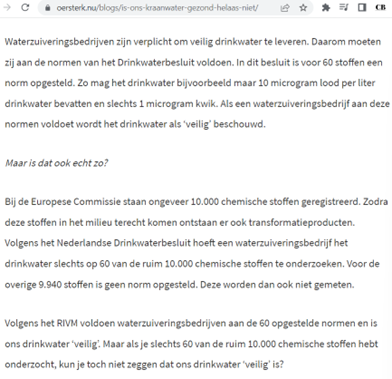
It is true that the drinkwaterbesluit (Dutch legislation that has to safeguard the quality, and so the safety, of our water) allows a small amount of very many chemical substances to be in the water. In Annex 1 of the drinkwaterbesluit you find a whole list of so-called threshold values: values for substances that the value found during inspections must not exceed. But nowhere in this decree does it say what these values are based on. Richard also claims that some 10,000 chemical substances are registered with the European Commission and that water treatment companies only have to check about 60 substances to consider the water safe. According to him, that is not enough to label our water as safe.
Refuting two things
Before I dive into the literature behind the threshold values, I first want to refute two things from Richard's blog. First, the fact that a substance is registered in REACH (and so with the European Commission) does not mean that it can end up in our drinking water or that it can be harmful to our health (more on this in a moment). So it would be ridiculous to check our drinking water for all the substances that are registered. Second, it is a very strange assumption that testing for 60 substances is not enough to judge the water as safe. Considering that a water filter like Aquatru is tested on about the same number of substances. So why then trust the safety of the water from the water filter?
Reading guide
I decided to contact Food Claims Centre Venlo, specialists in legislation on food and health claims, and ask whether they knew more about this. They told me about the existence of REACH (European legislation) and the thinking behind the drinkwaterbesluit. However, the deeper I dived, the more documents and organisations I came across. I therefore decided to discuss the organisations and their approach to setting threshold values in general terms. Then I take two examples: lead and ‘other anthropogenic substances’. For both examples I looked at the justification for the threshold values in the drinkwaterbesluit. For lead this consists of several documents: REACH, the World Health Organisation (WHO), the European Food Safety Authority (EFSA), the Gezondheidsraad and the Rijks Instituut voor Volksgezondheid en Milieu (RIVM). For anthropogenic substances this is mainly one document.
By going through this using examples I hope to give you more insight into the thinking and literature behind the threshold values. The aim of this blog is not to give you advice on whether or not to buy a water filter. All I want to achieve is to give you insight into the legislation (and science) behind our tap water, so that you can make an informed choice yourself on whether or not to listen to pro-water-filter people.
I begin with what I learned from this dive. A kind of summary.
What did I learn? (4 lessons as a summary)
Let me get straight to the point: was I shocked by how many chemical substances we take in every day? Yes. Am I therefore going to bring a water filter into my home? No.
I am going to be completely honest. Because of a lack of time and a lack of toxicological knowledge, I technically could not dive as deep as I normally do with studies related to nutrition science. Still, I learned a lot about where the threshold values set in the drinkwaterbesluit come from. I am going to summarise this in a number of lessons. If you want to know what I base these lessons on, you can find it in the rest of the blog.
Lesson 1: 0 exposure is a utopia
Nowadays chemical substances are everywhere: in our food, drinks, clothing, personal care products, interior, toys, detergents, kitchen utensils etc. Still, being exposed to these substances is not something new.
The number of substances we are exposed to has made a big leap especially since the industrial revolution. Still, we started using metals thousands of years ago. And when you use something, you are exposed to it. It is estimated that we humans have already brought some 5 million chemical substances into the world. In 1980 only 100,000 of these substances were registered with the EU. Since 1980 we have become stricter about registering, and now 26,000 are registered in REACH. REACH is our (Europe's) first system that ensures careful registration with a dossier full of scientific literature about the risks to our health. Besides a strict registration system, our measuring instruments have become much better. As a result, substances can be measured down to a nanogram. This is 0.000000001 gram. This means that only now do we see for the first time which substances we actually take in. This is frightening, because it turns out to be quite a lot. On the other hand, this has led us to reduce exposure to substances considerably. Certainly here in the Western world. (we tend to forget that privilege) If you look at lead, for example, we had some 60 ug/dL of lead in our blood in the 60s. This is 30 times as high as now. Especially in children, halfway through the 19th century, at population level, exposure to lead caused a significant decrease in IQ points, how bizarre is that.
In an ideal world we reduce exposure to chemical substances to 0. I just wonder how realistic that is. Over the past thousands of years we have brought millions of substances into the world, and fortunately many of these have been reduced to micrograms (0.001 gram) and nanograms (0.000000001 gram). 0 is a utopia.
Lesson 2: The safety standards are not guesswork
In the criticism of our tap water I sometimes sense the feeling that the safety standards are a bit of guesswork. Only a limited number of substances would be measured, and there would be little knowledge about the long-term effect of the substances on our health.
I think this criticism is too simplistic. Everything is done to collect the basic toxicological information about substances: absorption, distribution, metabolism, excertion and elimination. In other words, toxicokinetics. When you know how a substance behaves in the body, you can make a calculation of the effect of a substance on our health. I was amazed by what kind of research with humans has been done on lead -- there is even experimental research in which babies were given lead.
Of course there is not a gigantic database of scientific literature for every substance (as there is for lead). Still, toxicological knowledge can be used to look at the properties of substances, compare them with substances we do have a lot of knowledge about, and make a calculation on that basis. This is not guesswork.
The quality of our drinking water is safeguarded at different levels: worldwide (WHO), European (ECHA) and national (the Gezondheidsraad and the RIVM) -- but the most important level is the local one. The KWR works with drinking water companies every day to supply us with safe drinking water. They keep an eye on all substances in our drinking water and have set strict threshold values for themselves, sometimes stricter than worldwide or European threshold values. The ‘other anthropogenic substances’ category gives drinking water companies room to take stock of which substances are relevant and/or new for a specific source. In this way drinking water companies found some 1,300 new substances since 1980. This is not because they are all new substances, but because our measuring instruments keep getting better. The substances were already there. These precautionary standards (such as the ‘other anthropogenic substances’ but also the standard for pesticides) make sure that drinking water companies also protect us from substances that have not been measured before or for which no database of scientific literature is available. Since the alarm bells already go off when a total of 0.001 gram (per category) of those substances is measured.
After spending many hours on the literature that underlies the safety standards of our drinking water, I get the feeling that most people who criticise these standards have no idea how much justification there is. They have never really taken the time to look seriously at the justification for the safety standards of our drinking water. There is often an appeal to feeling instead of criticism on substance. So the safety standards are not guesswork. The criticism is guesswork.
Lesson 3: exposure through drinking water is negligible
Still, you can say ‘even if it concerns such small amounts, I do not want that in my body at all’. Fair enough. Unfortunately I have to disappoint you then. As I said earlier, 0 is a utopia. I also said that I was shocked by how many chemical substances we take in. This is just not through drinking water, but through our food and the air. When the threshold values for our drinking water were set, other routes through which we take in the same substances were taken into account. The biggest source is food, but we also get junk in through our airways. For almost all substances, drinking water is usually only 1% of the total you take in. Almost all our food contains chemical substances, because plants are sprayed with shit and drink water that has not been treated yet. In addition, the animals we eat eat the same plants and also drink that same untreated water. So even unprocessed products are full of shit. Much more than in our drinking water. And that is the reason why I will not buy a water filter. I am more inclined to look at which food I can best buy and in which place I can best live, than to spend money on filtering that 1%.
Of course, if you do want that, you should definitely do it. But an underlying lesson I learned during this dive is that if you can get worked up about this at all (and have the money for a water filter), you have an incredible amount of privilege.
Lesson 4: It is all about trust
After reading various sources that are critical of the science behind our tap water, I realise all too well that this is not about the science. It is about trust. If you no longer have trust in the government or other bodies that are supposed to watch over our health, then you buy a water filter. The KWR and drinking water companies can shout from the rooftops that they do everything to provide safe drinking water. If there is no trust, that falls on deaf ears.
I understand that, in a way. The government has let us down on many points concerning health. Health care is not what it could be and many people feel abandoned by the medical system. Certainly after so many stories about financial interests, corruption and inequality in care. Unfortunately I can do nothing other than give a description of everything that lies behind the threshold values that are supposed to keep our drinking water safe. Hopefully this restores some trust in some people. But if you no longer have trust in the government or science, then you buy a water filter.
The start of the dive
Now you might think ‘What is this guy basing all this on? What is your source!?’. Very good! I would say enjoy the read:
European level: REACH
REACH stands for Registration, Evaluation, Authorisation and Restriction of Chemicals. It is both legislation and a registration system. At the moment more than 26000 substances are registered in REACH. These are all chemical substances that have been produced or imported within the European Union since REACH came into existence. This concerns substances used in industrial processes or found in everyday products such as cleaning products, paint, clothes, electrical appliances etc. The aim of the REACH regulation is to ensure a high level of protection of human health and the environment against hazardous effects of chemical substances.
- REACH: Regulation (EC) No 1907/2006 concerning the Registration, Evaluation, Authorisation and Restriction of Chemicals (REACH). You can find the whole law via this link.
How does REACH work?
A dossier has to be created in REACH for every chemical substance. In this dossier the risks to human health and the environment are recorded. When a company (or companies: if several companies want to work with the same substance they have to do it together) wants to import or produce a substance that is not yet registered, the burden of proof lies with the company to demonstrate what the risks are and whether/how they can be controlled. The ECHA (European Chemicals Agency) receives the individual registrations and assesses whether they meet the requirements. The EU member states evaluate the substances to decide whether any concerns raised about risks to human health or the environment are justified or not. The authorities and scientific committees of ECHA assess what the risks of the substances are and whether they can be kept under control.
Registration of a substance
When registering a substance, a company has to demonstrate how the substance can be worked with safely throughout the whole chain, and how the environment and human health are protected. All of this has to be stored in a registration dossier. What has to go into the dossier depends on the amount of the substance that is placed on the market, on the hazards of the substance and on whether the substance is (can be) used as an intermediate for other substances.
In the end the dossier contains information on the physico-chemical, ecotoxicological (poisonous to the environment) and toxicological (poisonous to humans) properties of the substance, and an assessment of the hazards and risks that makes clear how the risks connected to the use of the substance are controlled.
The fact that a substance is registered therefore says nothing about how safe or unsafe it is; it is a legal obligation to collect information about substances and their properties and to state this on a safety data sheet. Nor does it say that humans and the environment come into contact with the substance at all (e.g. via tap water), but if they do, this has to be stated in the dossier.
Assessment of a substance
Toxicity: when a substance becomes poisonous and thus bad for the health of humans.
The substances are assessed (where necessary) on the following points: genotoxicity (damage to DNA), toxicity after acute and repeated administration, prenatal developmental toxicity (damage to babies / foetuses), reproductive toxicity (damage to reproductive organs), carcinogenic properties, long-term aquatic toxicity (damage to aquatic life in rivers etc.), biodegradation (how quickly does it break down) and bioaccumulation (does the substance build up in humans or other organisms).
And this is where it gets really interesting. We want to know how it is proven from which amount a substance becomes toxic and thus unsafe for us (threshold values). For example via drinking tap water. I take you through the process of assessing the substances that are registered in REACH. But as I said, it is a summary, since otherwise you would be busy for hours with this blog.
There are various ways in which information about the risks to human health may be gathered. Since experiments with humans (which of course have the highest strength of evidence) are not always allowed, for example when we expect a substance to be poisonous, a lot of information is taken from studies with animals. However, the European Commission wants to prevent unnecessary animal testing, and therefore alternative methods are offered. This can be using information from similar substances (read-across), combining information from different sources, e.g. epidemiological research (weight of evidence), computer models (QSAR) or research with bacteria, cells, tissues and organs (in vitro).
The risk that a substance poses to our health is based on two factors: Hazard (danger) and exposure. A substance can have a big effect (hazard) on our health, but if we are not exposed to it, it is not a problem. Conversely, a substance can have only a small effect (hazard) on our health, but if we are exposed to it daily it can still be a problem (such as chemical substances in drinking water). So evidence has to be provided for both the hazard and the exposure at registration. For now I mainly focus on the evidence for the hazard; the exposure we are interested in we know: tap water, and so it concerns repeated-dose toxicity.
Hazard assessment
The hazard assessment consists of several steps. I walk you through them:
Step 1: Collect all existing information (read: evidence)
In step 1 the registrant has to collect all physico-chemical, toxicological and ecotoxicological information that is relevant and available to them, regardless of whether or not the information on a certain endpoint is required for this substance (e.g. based on the amount that is produced or imported of it).
This includes available study data;
-
data from other in-vivo (experimental research with animals or humans) or in-vitro (cells etc.) studies;
-
data generated with the help of alternative methods (e.g. computer models and read-across)
-
epidemiological data (observational research);
-
any other data that can help identify the presence or absence of hazardous properties of the substance.
Such information can be obtained from various sources such as internal company data from other manufacturers and importers of the substance through cooperation in a SIEF (REACH Article 29), at the request of the Agency (REACH Article 26) or from databases or other sources in the public literature or via the internet.
They also have to collect all information on the exposure, such as the route, frequency and duration.
Step 2: Weigh up the information needs
Based on the amount of the substance that is produced or imported and what/how large the possible risks to the health of humans and the environment are, it is determined how much information about the substance is needed.
Step 3: identify information gaps
The company that wants to register the substance has to check whether all the necessary information is available.
Step 4: Generate new information or propose studies
If there are gaps in information, new information has to be generated. The company has to submit a proposal for research that would provide the right evidence to fill the gap in the body of evidence.
The evidence
Let us talk about the evidence that companies have to provide as proof of the risks of the substance they want to import or produce.
Topics on which relevant information (read: evidence) has to be available:
-
identity of the substance;
-
physico-chemical properties;
-
exposure/use/occurrence and applications;
-
toxicity to mammals;
-
toxicokinetics;
-
chemical substance category;
-
ecotoxicity;
-
behaviour and distribution in the environment, including chemical and biotic degradation.
The sources the information may be taken from:
-
internal files of companies and trade associations (including test data);
-
data banks and databases of collected data;
-
approved data sets such as the OECD's HPV Chemicals Programme;
-
published literature;
-
internet search engines and relevant websites;
-
(Q)SAR models;
-
data exchange in the substance information exchange forum (SIEF).
SIEF is a system where all current information is stored. Companies can search in it so that duplicate research is prevented.
Research with humans that can be used:
-
Analytical epidemiological studies of exposed populations (case-control studies and cohort studies): are useful for identifying an association between human exposure and effects.
-
Descriptive or correlational epidemiological studies: are useful for identifying areas for further research, but on their own are not usable for a full risk assessment, because they can often only identify patterns or trends but cannot show a causal link.
-
Case reports: can show effects that are not observed in laboratory animals. The reliability and relevance of the reports have to be assessed carefully, because critical information about e.g. purity of the substance, human exposure and effects is often missing from these reports.
-
Experimental studies with human volunteers: are acceptable in very rare cases. Tests with human volunteers are strongly discouraged, but if data of good quality are already available, these may be used where appropriate in well-motivated cases.
An important topic for human health: Toxicokinetics
Toxicokinetics and science
When assessing the hazards to human health, the toxicokinetic profile of the substance has to be weighed up. The toxicokinetic profile of a substance describes its absorption, distribution, metabolism and excretion. This is also very important for research into the bioaccumulation of the substance: the longer a substance stays in the body, and the more of it is taken up and stored, the greater the chance that it builds up in the body and still causes damage to health at a low dose but repeated administration (this often happens in fatty tissue). It therefore has to be clear how much of the substance is taken up into the blood and cells (of organs or bones). It is also important to know how quickly cells are saturated with the substance (so that nothing more is added) and what the half-life of the substance in the body is (how quickly and via which route it leaves again). This is also called: absorption, distribution, metabolism, excertion, elimination and the sum of all this: disposition.
If we know how this works in humans, then with results (from scientific research) and through toxicokinetic modelling we can give an estimate of the effect of a substance on human health. A conservative estimate is made here, taking into account uncertainties, e.g. about the fact that animals and humans are not the same (but humans themselves are not either).
For this, scientific research has to look at two things (when we talk about drinking water):
Acute toxicity: Harmful effects that result from a single or short-term exposure to the substance.
Repeated-dose toxicity: Repeated-dose toxicity relates to the general toxic effects that occur after daily dosing with a substance for 28 or 90 days or for a large part of the lifespan in the case of chronic exposure. The effects studied in these studies can include changes in morphology, physiology, growth or lifespan, clinical chemistry or behaviour. The most obvious exposure (via skin, mouth or inhalation) has to be chosen here.
In animal experiments the highest dose that causes toxicity but not death has to be chosen, then ever lower doses are chosen to show a dose-dependent response, and finally a dose at which no harmful effects are seen. In other words, the No Observed Adverse Effect Level (NOAEL).
Scientific research on repeated-dose toxicity of the substances has to be of such a nature that it shows a causal link between dose, response and effect. So that a limit value (threshold value) can be set.
For establishing repeated-dose toxicity no in-vitro studies or QSAR (computer models) have been approved yet. If a substance shows no acute toxicity at 1000mg/kg body weight, repeated-dose toxicity does not have to be investigated.
In-vitro research is often used, though, to investigate the metabolism around a substance. After that, In-sillico studies are used (medicinal chemistry experiments with computer models) to understand absorption, distribution, metabolism and elimination of the substance. Finally, studies with humans are used, such as biological monitoring and biomarker studies, to follow and investigate substances in the human body.
Threshold values
An important aim of registering a substance in REACH is to guarantee that manufacturers (and other companies) make, place on the market or use substances in such a way that they are not harmful to human health. To assess this, a comparison is made between the expected exposure and the potential for harmful effects.
The ultimate aim is to set threshold values: the No Observed Adverse Effect Level (NOAEL), and on the basis of this the Derived No-Effect Level (DNEL) is derived. This gives the maximum amount that humans may be exposed to. The DNEL is calculated by dividing the NOAEL by assessment factors that reflect uncertainties (e.g. differences between species, differences in sensitivity between humans and the quality of the database).
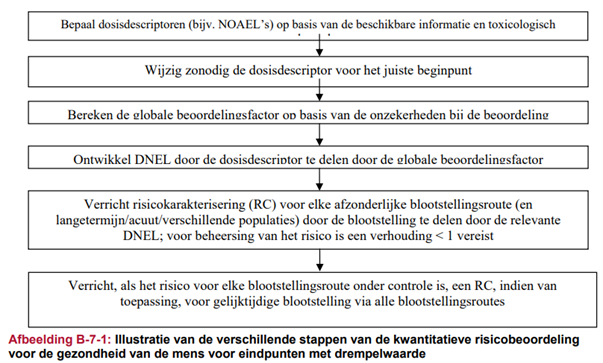
With regard to the derivation of DNELs, REACH specifies among other things that it may be necessary to identify different DNELs for each relevant population of humans (e.g. workers, consumers and people who are exposed indirectly via the environment) and possibly for certain vulnerable subpopulations (e.g. children, pregnant women) and for different exposure routes (oral, skin and/or inhalation) and for varying exposure duration (a single incident up to continuous exposure for a number of days/weeks/months per year).
The DNEL can be seen as a 'global' derived dose without effect for a certain exposure (route, duration, frequency), taking into account uncertainties/variability in these data and in the exposed human population.
REACH in summary
What is REACH?
REACH stands for Registration, Evaluation, Authorisation and Restriction. It is both legislation and a registration system for all chemical substances that are both produced and imported in Europe. This is kept up by the European Chemical Agency (ECHA) together with all member states of the European Union (EU). More than 26000 substances are registered in it at the moment. But the fact that they are registered does not say that they can end up in our drinking water or that they are harmful to our health. Although the registration does make clear whether this is the case.
The aim of REACH is to protect the health of humans and the environment at a high level against hazardous effects of chemical substances.
How does REACH work?
For every chemical substance that is used within the EU, a dossier is created with all possible risks to humans and the environment. This means that both the hazards of the substance and the way it can end up with humans and the environment have to be known. This is assessed both by scientific committees of the ECHA and by EU member states. If there is a possibility that humans are exposed to the substance, then a threshold value is set on the basis of scientific literature (which is stored in the dossier): the maximum amount that humans can take in at which no harmful effects occur.
Registration of a substance
When a substance is not registered in REACH, it is up to the company (or companies) that is going to produce or import the substance to provide evidence for the physico-chemical, ecotoxicological (poisonous to the environment) and toxicological (poisonous to humans) properties of the substance, and an assessment of the hazards and risks that makes clear how the risks connected to the use of the substance are controlled.
Assessment of a substance / Hazard assessment
When we look at the effect of a substance on our health, a substance is assessed on two things: Hazard (danger) and exposure. A substance can have a big effect (hazard) on our health, but if we are not exposed to it, it is not a problem. Conversely, a substance can have only a small effect (hazard) on our health, only if we are exposed to it daily it can still be a problem (read: drinking water). So evidence has to be provided for both the hazard and the exposure at registration.
The assessment of the hazard is based on all existing information that is available: This includes available study data, data from other in-vivo or in-vitro studies, data generated with the help of alternative methods (e.g. computer models, read-across and weight of evidence), epidemiological data (observational research) and any other data that can help identify the presence or absence of hazardous properties of the substance.
On this basis it is assessed whether more research into the substance is needed and which research. If so, a company has to make a proposal for a study that would be suitable for the missing information.
Toxicokinetics and science
An important property of a substance that has to be clear is the toxicokinetics of the substance. This is about how a substance is taken up and processed by the body. This tells us exactly what happens to the substance in the body: how does it get in? how long and where is it stored? How do we excrete it again?
With these data we can make an estimate of threshold values with chemical models. For this, for both the acute toxicity (how much of the substance can we take in before we suffer damage directly) and repeated-dose toxicity (how much and how often can we take in the substance before we suffer damage).
Threshold values
When all the necessary information and scientific evidence is available, we can set threshold values. From the literature we take a No Observed Adverse Effect Level (NOAEL) = at which amount do we suffer no damage. On the basis of the NOAEL the Derived No-Effect Level (DNEL) is calculated. This is done by multiplying the NOAEL by an assessment factor. The assessment factor takes into account uncertainties such as differences between species (animal vs human), differences between humans (for example vulnerable populations such as children) and the quality of the data that is available and the duration of exposure.
Examples
To make this clear I take two examples. I am very curious what all this theory looks like in practice. All the dossiers of all substances that are registered are public, after all. For each example I will also dive into reports of other relevant organisations: WHO, EFSA, the Gezondheidsraad and the RIVM. I take as the first example one that Richard also cites in his blog: Lead.
Example 1: Lead
Lead is a chemical substance (metal) about which an incredible amount is known. That is not strange. Since exposure to lead has been gigantic over the past hundred years. Mainly because it was in petrol (and so in exhaust fumes) and paint (and so on all houses etc.). Because of the large exposure to lead, and because it became clear decades ago that lead is possibly harmful, lead has been included in the REACH registration system. But besides that, reports have also been written about it by various organisations. We begin with the dossier of lead in REACH.
In the dossier lead is recognised as a substance that mainly causes damage to organs when humans are exposed to it for a long time (chronically). Including the brain. An important finding over the past century was therefore that children in particular are susceptible to neurological damage from lead and that IQ can therefore drop considerably. Which of course has a gigantic impact on an individual but also on society as a whole. Lead can enter via the skin (low absorption), orally and via inhalation. It has therefore been given the labels ‘Danger’ and ‘Health Hazard’.
If we then look at the chapter ‘Toxicological information’ we find the following:
The summary states that for the ‘General population’ the (lowest) DNEL (derived no-adverse effects level) is 2ug/dL for children, 5 ug/dL for pregnant women and 20 ug/dL for adults in general. BUT it is important to mention here that these values are blood values. So this is independent of the route by which the lead enters.
There was no clear threshold value for when children can suffer IQ damage from lead poisoning. However, it was expected (based on other neurotoxins) that it can happen at 5 ug/dL in the blood, so a much lower level was chosen as the threshold value (2 ug/dL).
According to the ECHA the NOAELs (no observed adverse effect level) found were based on enough (strong) scientific research and very conservative. Therefore the NOAELs found were converted to DNELs with a factor of 1. Also, no threshold value was set for acute toxicity, since studies with animals showed that lead cannot be acutely toxic.
For all the considerations made for the DNEL I refer you to the dossier. Let us dive into the dossier.
Uptake of lead
If I have to believe the summary of the dossier, the NOAEL would be based on more than 100 studies with humans. Including experimental and observational ones, in which differences in age, gender, ethnicity, intensity and length of exposure could be evaluated. From experimental research it has become clear that we take up some 10% of the lead that we take in through our mouth. They literally gave people lead in an experimental study and looked at how much ended up in the blood or was excreted again. This study is also in the dossier. The strange thing is that this and several other studies are in the dossier without a source.
It is completely bizarre because I had found the study within 2 minutes of searching on the internet. So why is the source not simply included?
In the study 8 people in a hospital were given 100 ug (this is 10x as much as is allowed in our drinking water now) without and with 200 mg calcium and 140mg phosphate. In another instance a lamb was injected with lead, after which the animal was slaughtered after 6 days and the participants were made to eat the organs, milk and meat (what the f*ck). Both from blood and radiation measurements it turned out that the uptake of lead is about 10% when it comes together with food (and so with calcium and phosphate). This can drop to 2% in the presence of 700mg calcium and 500mg phosphate. However, it can rise to 60% when it enters on an empty stomach without food (nutrients).
Fascinating if you ask me.
Observational research on lead
In addition, I am of course curious about the scientific evidence for the threshold values. So I went looking in the dossier, and mainly for studies with humans. And I can confirm that they can all be found. Dozens of studies that are described one by one. Too many for me to go through all of them. So I will pick one to give an insight into what kind of studies were used for setting the threshold values.
Sources:
I found a study that is part of the Cincinnati Lead Study Cohort carried out by Dietricht et al. and a university plus a hospital in Cincinnati. Cincinnati is a city in Ohio (USA). At the time (+/- 1980) of this study there was still a lot of exposure to lead. In the 60s the average blood values of lead in both children and adults were some 60 ug/dL. Realise: that is 30x the DNEL for children. Through various measures, but mainly through the removal of lead from petrol, this had been lowered to 25 ug/dL in the 80s. However, because a lot of paint still contained lead, and the paint came loose because of the weather, many children still got lead in while playing outside. The aim of this cohort was to measure the blood values of the pregnant mothers and then to follow more than 250 children and their cognitive function after birth for 4+ years.
Method: between 1979 and 1984 women were recruited who were not allowed to be addicted to drugs. The newborn children (of these women) could only take part in the study if they were healthy.
In the mother, lead in the blood was measured during pregnancy and after that every quarter in the children from 3 months to 4 years old. It went on for longer but for this study the data of children up to and including 4 years old was used. In the end, a complete data set was available for 77% of the children. The Kaufman Assessment Battery for Children was used to measure cognitive function. A gigantic list of potential confounding variables was included in the study, which could possibly disturb the relationship between lead and cognitive function, including physical health and psychosocial factors.
What strikes me (and I see this in many studies that were carried out on lead around the 80s) is that the research was mainly carried out on poorer people. Probably because exposure to lead was higher here than in richer neighbourhoods. So this cohort mainly involved black people with a lower socio-economic status.
There is no table where you can see the differences between the baseline data of the groups. A pity, this could give a good picture of what the difference between the groups was at the starting point.
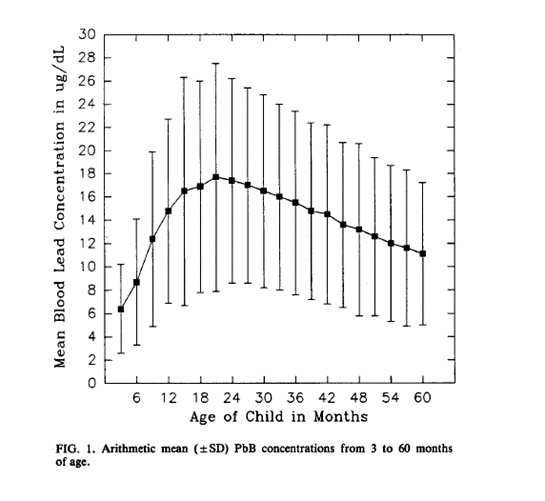
There was a considerable spread in the lead blood values between the children within the groups, which rose from 0 to 24 months and then slowly decreased. Whereby in none of the children were the blood values ever below the DNEL of 2 ug/dL.
In the end it turns out that the higher the lead blood values, the lower the cognitive function of the children. Also after controlling for many potential confounders. The increase was smaller after controlling for confounders, which also says something about how important the other factors are for the cognitive function of children, such as physical health and psychosocial factors. (food for thought)
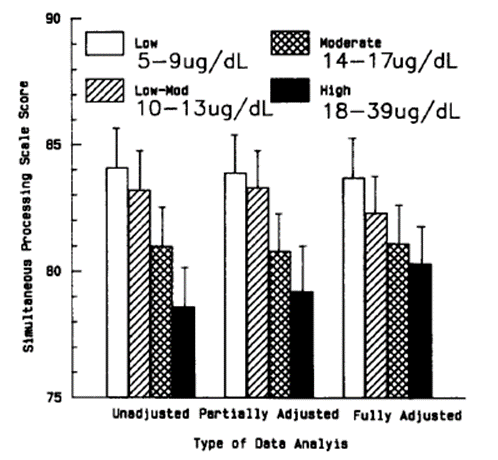
This also applies to the IQ of the children. Whereby the most significant decrease in IQ was at an exposure of 20 ug/dL and higher.
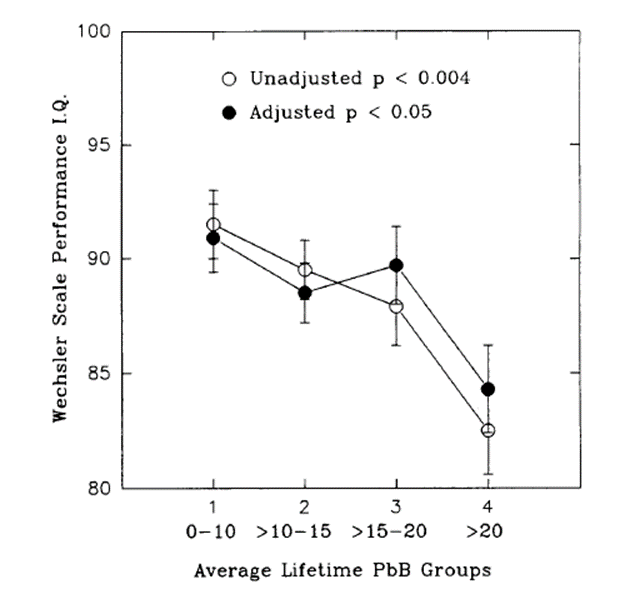
It is stated that studies were assessed on quality and with which method. By whom and the result of the quality assessment I cannot find. The study that I highlighted of course has caveats. It is a (prospective) observational study, which is never enough for a causal link. I also do not know how reliable the test instruments for cognitive function for children are. And whether these tests are even still used as a validated instrument. In addition, you cannot tell from this study whether the 0-10 ug/dL group suffered damage, because it is not compared with a group that has no lead in the blood (those children were not there, namely). However, the ECHA bases the threshold values on all available literature. That is as it should be. You never make guidelines or strong claims based on one study. For me it is impossible to dive into all the literature that is available, though. This means that it comes down to trust. Do you trust that the scientific committees have assessed and summarised the literature in a correct way?
Worldwide level: World Health Organisation
But as I said earlier, the threshold values for our drinking water are not based on REACH alone. The drinkwaterbesluit is namely based on the European Directive on the quality of water intented for human consumption: a directive/legislation drawn up by the EU. There you find almost the same threshold values as in the drinkwaterbesluit. Also, just like in the drinkwaterbesluit, without justification. So I started emailing around, and the Inspectie Leefomgeving en Transport (ILT; the human environment and transport inspectorate) of the ministerie van Infrastructuur en Waterstaat told me that the threshold values are based on reports from REACH, the WHO and the EFSA. But a member state may decide itself to make threshold values stricter (for example if the Gezondheidsraad or the RIVM considers that necessary).
Let us take a short dive into the guidelines for safe drinking water of the WHO. The first WHO guideline was published in 1958 and since then it has been updated some eight times. The aim is clean drinking water for everyone in the world. The Chemical Safety Unit and the Risk assessment and Management Unit of the WHO make reports on all possible chemical substances in our tap water, in which the Hazard (danger) of these substances is estimated. They too set threshold values and have this done in a peer-reviewed risk assessment in which every chemical substance gets its own report. Anyone can view these.
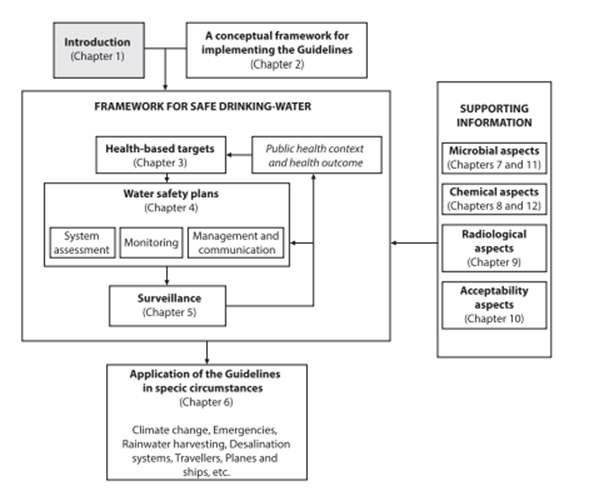
Risks of drinking water
According to the WHO, safe drinking water is water that, when consumed over a whole lifetime, poses no significant risk to our health, taking into account different vulnerable life stages (e.g. children and pregnant women). They stress that the guidelines the WHO sets have to be met, but that member states should always focus on doing better.
“Although the Guidelines describe a quality of water that is acceptable for lifelong consumption, the establishment of these Guidelines, including guideline values, should not be regarded as implying that the quality of drinking-water may be degraded to the recommended level. Indeed, a continuous effort should be made to maintain drinking-water quality at the highest possible level.”
Then you can ask yourself what the WHO means by a ‘significant risk’. They base this on Disability-adjusted life years (DALY). This is calculated from how many years earlier someone dies plus how many extra years someone has to live with a disability or disease. On the basis of this a risk is calculated. The guidelines of the WHO are based on a 10 ⁻⁶ DALY. Which means that 1 extra case of death, disease or disability per 1,000,000 people may occur among people who drink drinking water their whole life. In other words, a risk of 1 in 1,000,000. You would do better to play the bankgiroloterij lottery; then your chance of winning a million euros is 1 in 790,000.
Health targets
To guarantee safe drinking water the WHO has set several “health-based targets”. These include health outcome, water quality, performance and specified technology. Health outcome is based on the overarching 10 ⁻⁶ DALY risk that people may run when drinking water. In addition, the risk is assessed for chemical substances individually, which falls under water quality.
The WHO makes, as far as I am concerned, an important caveat to these targets. They state that almost all substances that can be in our water enter us to a much higher degree via other routes: the air, food, contact between people or poor hygiene. Therefore these targets always have to be seen in the context of all other possible exposures to the same hazards and be part of a holistic plan to protect the health of people.
“Although water can be a source of microbial, chemical or radiological hazards, it is by no means the only source. In setting targets, consideration needs to be given to other sources, including food, air, person-to-person contact and consumer products, as well as poor sanitation and personal hygiene… When defining mandatory limits, it is preferable to consider the Guidelines in the context of local or national environmental, social, economic and cultural conditions. The Guidelines should also be part of an overall health protection strategy that includes sanitation and other strategies, such as managing food contamination.”
The targets for chemical substances have to be both scientifically supported and practically feasible and protect our health. Our measuring instruments determine the feasibility. It makes no sense, of course, to set a threshold value below the minimum level that our instruments can measure.
The fact that our drinkwaterbesluit contains threshold values for relatively few chemical substances (as Richard cited) is called “short-listing”. This means that a member state gives priority to substances that it thinks can be in our water at all. On the basis of the amount that can be enough for harm to our health. In addition, many chemical substances are found together, which means that when one substance is present, another substance probably is too. Therefore they check for only one of those substances.
“In some cases, there are groups of chemicals that arise from related sources—for example, disinfection byproducts (DBPs)—and it may not be necessary to set standards for all of the DBPs for which there are guideline values. If chlorination is practised, the trihalomethanes (THMs) and haloacetic acids (HAAs) will be the main DBPs. If bromide is present, brominated as well as chlorinated DBPs will be produced. Maintaining THM and HAA concentrations below the guideline values by controlling precursor compounds will provide adequate control over other chlorination by-products.”
WHO and threshold values
After reading the WHO document I come to the conclusion that they work on formulating threshold values in almost the same way as REACH. They do this for every chemical substance where;
-
There is evidence that a chemical substance can be in drinking water and possibly has harmful effects;
-
A chemical substance is an international hazard;
-
A chemical substance is a recognised pesticide that can end up in drinking water.
For the threshold value they use research with humans as much as possible, but where this is not possible research with animals is used. When it concerns studies with animals, these are always studies with few animals in which very high doses are used, which creates uncertainty about how this translates to the effect on the health of humans. Therefore these results are always checked with other research as much as possible and uncertainty factors are used to set conservative guidelines. Where REACH mainly used the NOAEL (no observed adverse effect level) and the DNEL (derived no effect level), this is different at the WHO.
First a TDI (tolarable daily intake) is calculated by dividing a NOAEL or LOAEL (lowest-observed adverse effect level) or BMDL (lower confidence limit on the benchmark dose) by a UF (uncertainty factor) or CSAF (chemical specific adjustment factor)
Then that TDI is multiplied by BW (body weight) and P (how much of the TDI can possibly be in drinking water) and divided by C (how much drinking water someone drinks) to set the possible guideline.
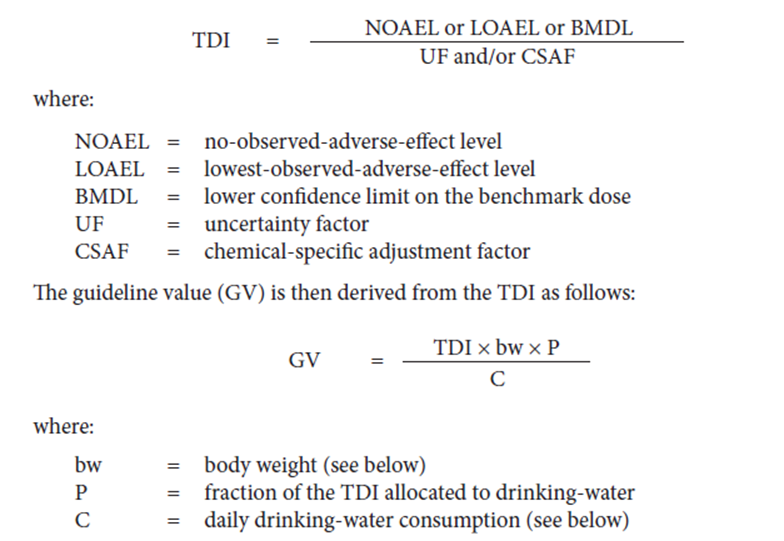
At the WHO too, all scientific evidence is assessed for reliability and quality. Then a factsheet is made for every chemical substance that could possibly be in our drinking water. These can all be found online.
“For each chemical contaminant or substance considered, a background document evaluating the risks for human health from exposure to the particular chemical in drinking-water was prepared. During the preparation of this background document, careful consideration was given to information available in previous risk assessments carried out by the International Programme on Chemical Safety, in its Environmental Health Criteria monographs and Concise International Chemical Assessment Documents, the International Agency for Research on Cancer, the Joint FAO/WHO Meeting on Pesticide Residues and the iv Joint FAO/WHO Expert Committee on Food Additives (which evaluates contaminants such as lead, cadmium, nitrate and nitrite, in addition to food additives).”
Factsheets example lead
Let us look at the factsheet on lead.
On the factsheet you find everything about the substance. This too reminds me of the REACH dossier. All chemical-physical properties, how much of the substance is in our environment and what the exposure is for humans can be found in the factsheet (and the background document). So also the toxicokinetic profile (Absorption, distribution,
metabolism, excertion, elimination and the sum of all this: disposition) of the substance. You also find all the scientific research on possible effects on health and the threshold values that follow from it.
Exposure to lead
It becomes clear straight away that the biggest source of lead in drinking water is the water pipes of homes. In the Netherlands it is also known that if you live in a house built before 1960 you have to check whether your pipes are made of lead and have them replaced. But also in a new house, with a new tap or new pipes, it is important to flush the tap water first, because in the first 3 months there can still be lead in it. I had no idea about that…. And this is important because this source of lead in drinking water comes after a treatment plant filters your drinking water.
Measurements have been carried out in various countries, for example by checking in sewage water, which produced an overview of total lead intake in different countries. 90 ug/day in Belgium, 24ug/day in Sweden and 177 ug/day in Mexico. Some 80% of that enters via the mouth, but not through drinking water, but through food, among other things.
“More than 80% of the daily intake of lead is derived from the ingestion of food, dirt and dust. At 5 µg/l, the average daily intake of lead from water forms a relatively small proportion of the total daily intake for children and adults, but a significant one for bottle-fed infants. Such estimates have a wide margin of error.”
Toxicokinetics
Adults absorb some 10% of the lead that gets into the body. In children this can be 4 to 5 times as high. However, a low iron and calcium intake leads to a higher lead absorption. This is due, among other things, to the fact that lead is mainly taken up in red blood cells. Which contain iron. Lead is ultimately stored both in organ cells and in bone cells. In bones it can stay for some 17 to 27 years. All of this causes damage to health when the chronic exposure is too high.
Research with humans
As we know from the REACH report, there is a large body of evidence for the effects of lead on our health. The WHO describes this research, the results and the NOAEL that was derived from it.
The studies that surprised me most, but do lead to the strongest evidence, are (dozens of) metabolic studies from the 80s that they did with babies. In a kind of laboratory setting they gave these babies lead via bottle feeding to see which dose caused a significant rise in the blood and how much was excreted via faeces. Babies came to the laboratory for up to 72 hours, then went home for 11 to 18 days, and then 72 hours again. Sometimes this went on for as long as 746 days.
Zeigler et al. Absorption and Retention of Lead by Infants. (1978)
Rye et al. Dietary intake of lead and blood lead concentration in early infancy. (1983)
This showed that at an intake of up to 3-4 ug/kg all the lead was excreted via faeces and so no lead was stored in the body.
Threshold values
Still, the WHO has set a guideline of at most 10 ug/L for drinking water. They stress that this is not a health-based threshold value, but more based on feasibility. Since amounts lower than 10 ug/L are almost not achievable by treatment plants, and in addition the source of lead in drinking water arises after the treatment and so it would have to be measured after it comes out of the tap at people's homes.
Even though the research in babies showed that, at low amounts of lead, the lead is not stored in the body, a lot of scientific research afterwards did show associations between lead intake and health problems. To be on the safe side, the WHO therefore advises every country to get lead intake as low as possible. However, as stated earlier, drinking water is only a small factor in our total intake of lead.
“There remain uncertainties associated with the epidemiology, which relate to very low blood lead levels and end-points that are affected by many factors. Nevertheless, because lead exposure arises from a range of sources, of which water is frequently a minor one, and as it is extremely difficult to achieve a concentration lower than 10 µg/l by central conditioning, such as phosphate dosing, the guideline value is maintained at 10 µg/l but is designated as provisional on the basis of treatment performance and analytical achievability. As this is no longer a health-based guideline value, concentrations should be maintained as low as reasonably practical and should not be allowed to increase up to the provisional guideline value… It needs to be recognized that lead is exceptional, in that most lead in drinking-water arises from plumbing in buildings, and the remedy consists principally of removing plumbing and fittings containing lead, which requires much time and money.”
The plan now was to move on to national organisations that focus on the quality of our drinking water. However, I came across the following in a report of the RIVM:
“In 2010 the European Food Safety Authority (EFSA) carried out a risk assessment of lead and concluded that the health-based guidance value valid until then (the ‘Provisional Tolerable Weekly Intake’; PTWI) for lead of 25 µg/kg body weight per week can no longer be considered safe (EFSA, 2010). EFSA has instead derived various BMDLs (‘benchmark dose lower confidence limits’), which can be used as a reference point in the risk assessment (see chapter 3). Following this risk assessment the European Commission has proposed to halve the lead standard in the new European Drinking Water Directive to 5 µg/L. This concentration should be reached 15 years after the new directive comes into force. Formulating an unambiguous information message is therefore all the more topical.” (translated from Dutch)
In other words, the EFSA (the European food and goods authority) wrote a critical report on lead intake in 2010. They were of the opinion that earlier safety standards for lead intake were not low enough. I will first take you through the points I took from that report:
EFSA: Lead in food
The European food and goods authority: the EFSA. Published in 2010 a scientific opinion on lead in our food. The EFSA asked all member states to collect data. Their risk assessment came with a harsh message: the current lead intake is only just safe. Children in particular, with a high lead intake (by European standards), still run a risk of harm to health. Let us dive into the findings of the EFSA.
First they calculated the lead intake within Europe (and member states). In 2003 they started the research in which they asked all member states to send in data on lead in food and drinking water.
Lead in food groups:
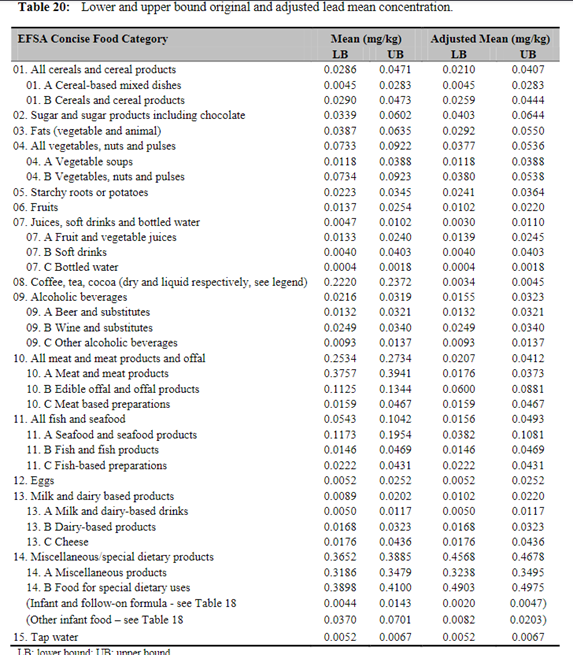
Intake per country:
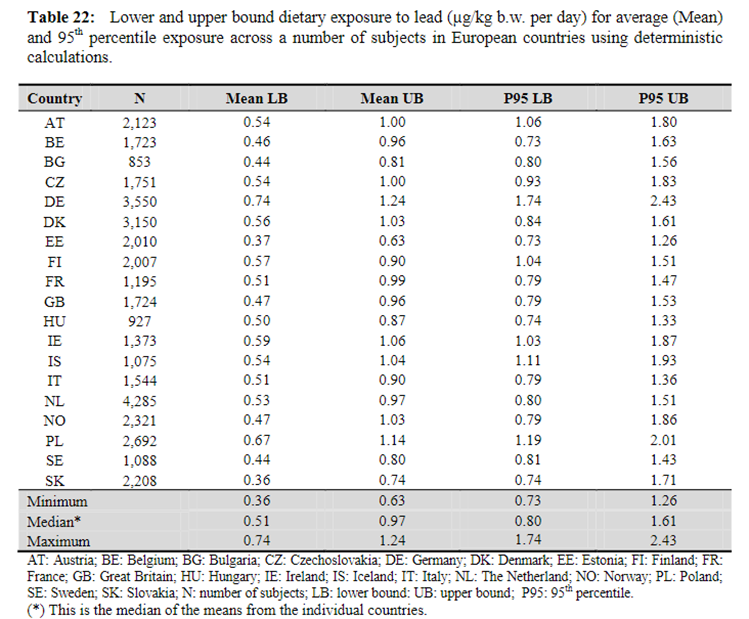
And finally also which food groups contribute most to the intake per country:
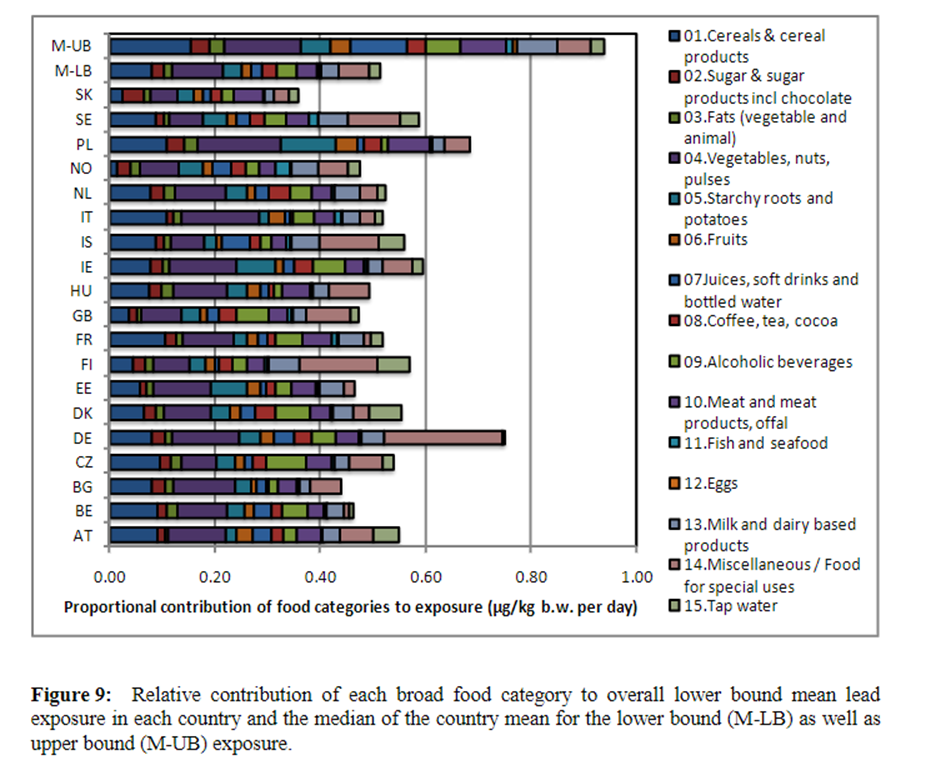
In summary: In the Netherlands the average intake of lead is between 0.53 - 0.97 ug/kg per day. This is almost equal to the average of Europe: 0.51 – 0.97ug/kg per day.
In the Netherlands vegetables are the biggest source of lead (9.7%) followed by grain products (7.8%) and after that come dairy, meat, coffee/tea and alcohol (+/- 4%). Tap water is 1.7% of the intake of lead in the Netherlands.
In addition, the EFSA carried out a new risk assessment. They too went through and assessed all scientific research (from before 2010).
They concluded that, for example, neurotoxicity of lead, which often translates into complaints such as irritability, fatigue and headache but also worse scores on neuropsychological tests for attention, memory and motor functions, can already start at 20 ug/L (2ug/dL) lead concentration in the blood. This is just as high as the ECHA (REACH) concluded as a DNEL (derived no effect level) and so considered safe.
On the basis of all scientific literature threshold values have been set that assume that the risk of various negative health effects may not rise by more than 1%, the so-called BMDL01 (benchmark dose (lower confidence limit)). Here they use a statistical test to calculate a threshold value that stands for a dose that possibly does harm. Then they also calculate a kind of uncertainty around that dose. Finally they take the lowest level of that to be as sure as possible that no harm arises. This BMDL has in turn been converted into how many micrograms (ug) of lead someone may take in per kg body weight before negative effects occur, and then you get the following threshold values:
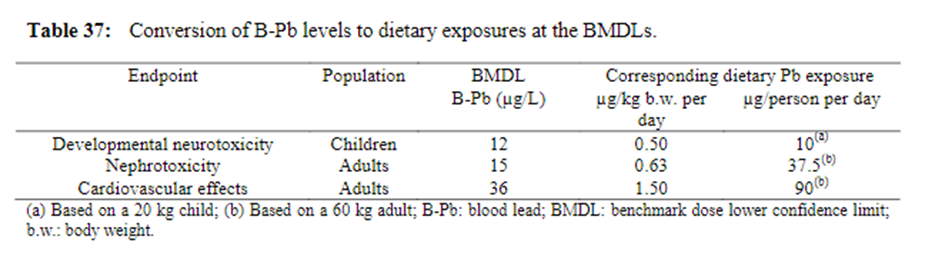
The results of the risk assessment led the EFSA to conclude that the current safety standard of 25 ug per kg body weight is not safe enough. Since in children an intake of 10ug per day can already cause neurological problems. Therefore they proposed to halve the lead standard in the new European Drinking Water Directive to 5 µg/L. This concentration should be reached 15 years after the new directive comes into force. Still I wonder how useful this is, since exposure to lead comes mainly from food and not from drinking water. More on this in a moment.
National level: The gezondheidsraad and RIVM
Then we have the national level -- our own national organisations that watch over our drinking water: the Gezondheidsraad and the RIVM. They too publish reports with research on possible risks of substances in our tap water.
For example, the Gezondheidsraad published a report on lead in our tap water. A few points I took from it are:
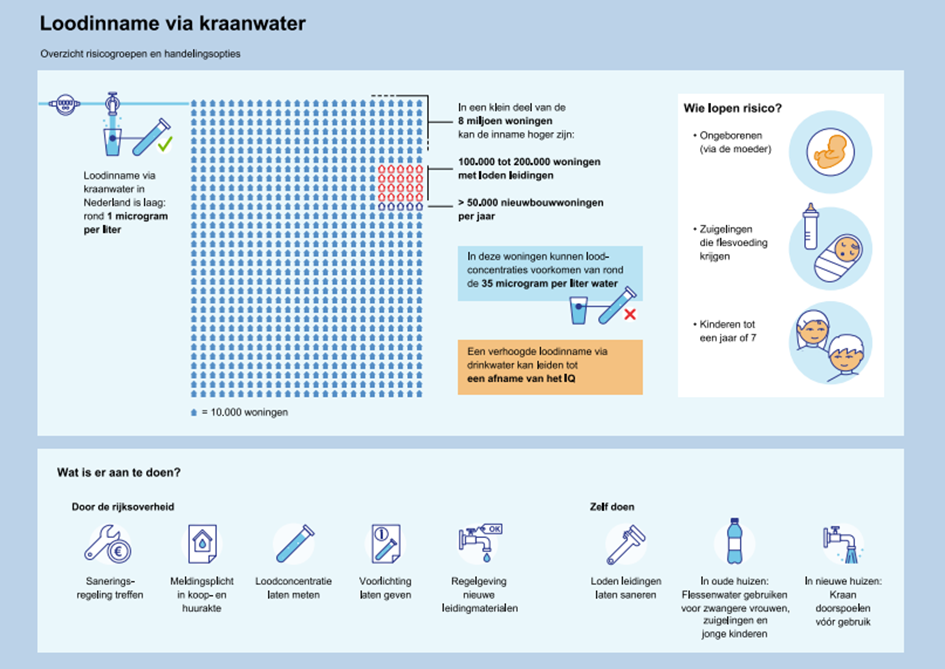
The biggest source of lead in our blood in the Netherlands was petrol and so exhaust fumes (which we breathed in, ended up in the ground and on our food). Something has been done about this worldwide, which is why this has decreased strongly over the past decades. And with it our exposure to lead. Around 2000 there was also a big campaign in the Netherlands by drinking water companies to replace lead pipes, which has also reduced exposure heavily. Still, there are people with lead pipes. It would not surprise me if these are mainly homes of people with a lower socio-economic status. The current average intake via our tap water is around 1 ug/L (a lot less than the threshold value of 10 ug/L and the new threshold value of 5 ug/L) and in 1% of the water samples an exceedance of the 10 ug/L was found. Still, it can go up to 35 ug/L in homes with lead pipes, which would still be a hundred to two hundred thousand homes (2019). But also in new homes you have to let your water flush through for the first 3 months before you drink it. Especially with small children under 7 years old and pregnant women! Who are extra vulnerable and take up more lead in the body than adults.
The RIVM also published a report on lead intake via tap water in 2019.
They conclude that:
“People can take in lead via tap water. This is especially the case in old houses that still have lead water pipes. Also, in houses with new pipes and taps that have not been flushed properly yet, there can temporarily be more lead in the tap water. The RIVM has calculated that in these situations tap water can make a large contribution to the total daily exposure to lead via food and water. For babies who are given bottle feeding with tap water from these pipes that contribution can rise to 80 percent. Residents in these situations take in more lead than what is considered safe.” (translated from Dutch)
Exposure to lead can, among other things, have a negative effect on the IQ of children. In adults it can give a higher chance of kidney disease or a higher blood pressure. However, we have already read earlier that for the whole population too high an exposure to lead can cause damage to the brain.
Many of the results in the report agree with those of the Gezondheidsraad. It is especially interesting to look at the intake calculations that the RIVM made.
The RIVM took two scenarios: 1. an average lead concentration in tap water without lead pipes = 1 ug/L and 2. an average lead in tap water with lead pipes or a newly built home (first three months) = 35 ug/L.
Then, on the basis of the Dutch monitoring programmes (carried out by the NVWA) and data from the EFSA, concentration and consumption data of lead in food in the Netherlands were calculated. This together with the lead in drinking water gave an average, median and high (95th percentile) intake of lead via food and drinking water (microgram/ug per kg body weight per day) calculated for different (risk) groups:
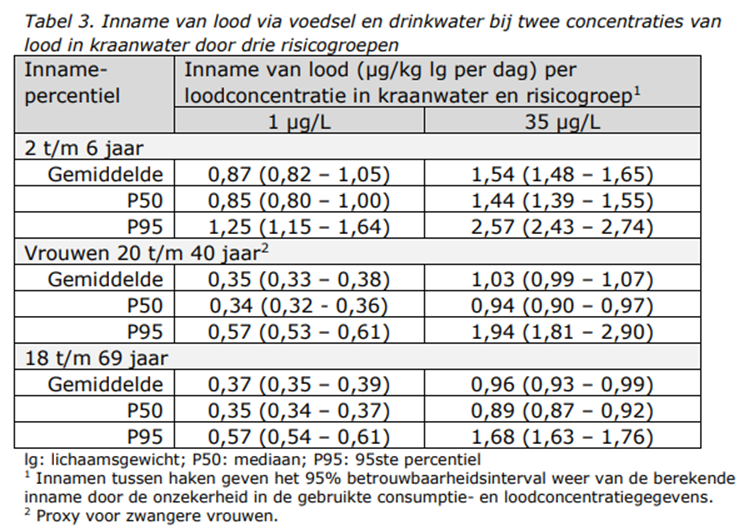
If I then look at myself on the basis of this value (in a house that is not a new build and has no lead pipes), I find the following:
70 x 0.37 = 25.9 ug (average) and 70 x 0.57 = 39.9 ug (95% highest intake) total lead intake per day.
If I did have lead pipes (and so, for a very long time, chronically took in these amounts), I find the following:
70 x 0.96 = 67.2 ug (average) and 70 x 1.68 = 117.6 ug (95% highest intake) total lead intake per day.
If I put this next to the 37.5 ug/per day for kidney disease and 90 ug/per day for cardiovascular disease, you see that even in a house without lead pipes I possibly take in too much lead….
If you then look at children, who may only take in 10 ug per day before it has an effect on their brain and nervous system, you see that a child of 1 year old who weighs 10 kg on average already takes in at least 8.7 ug (average) and 12.5 ug (95% highest intake).. this goes almost 2 times as high in a house with lead pipes…
I am scared to death. This is namely high, when you realise that an intake of 10ug on one day for a child is high enough for brain damage.
Of course this depends per person on where you live, what you eat and what you drink. Still, I find it worrying.
Example 2: anthropogenic substances
We move on to the second example: anthropogenic substances. I had no idea what it was, but I came across it in a post by Lars van den Nieuwenhoff. Owner of an alternative and holistic health service on Social media. His post caught my attention mainly because it was a lot more nuanced than other water filter supporters:
“I do not think filtering water in the Netherlands is the highest priority!” (translated from Dutch)
After which he continues that it is mainly a question of whether you have trust in the regulations of the government and water treatment organisations. He then says something interesting:
“They (government and water treatment organisations) state that the current way of water treatment is sufficient to meet the standards. The second question is then whether these standards are acceptable? For example, there is a limit of 1 microgram per litre of drinking water of “anthropogenic substances”. This can be anything. 1 microgram seems relatively safe, but how can you be sure of this when it concerns so many different substances. Sounds like guesswork.” (translated from Dutch)
According to him, anthropogenic substances are substances that have been brought into the environment by humans, and that can be anything: from medicine residues to antibiotics to chemicals. The fact that the drinking water may contain 1ug/L of them in total sounds like guesswork to Lars.
I became very curious. What are those substances? And what is that standard of 1 microgram (ug) per litre based on? Is it guesswork?
What are anthropogenic substances?
It is indeed very simple: all chemical substances with which the surface water and groundwater are burdened through human action.
Only, when you read the reason behind this standard, you find out that Lars's reasoning is not correct. Which shows that his claims are guesswork. The justification for the standard for other anthropogenic substances can namely be found in a document of the RIVM: Evaluatie signaleringsparameter nieuwe stoffen drinkwaterbeleid. (Evaluation of the signalling parameter for new substances in drinking water policy.)
Why the 'other anthropogenic substances' standard?
The standard for other anthropogenic substances has namely been included in the drinkwaterbesluit with an important aim: the signalling parameter is meant as a safety net for new, still unknown threatening substances for the drinking water supply.
Which substances fall under this standard differs per drinking water company, because it differs which substances may be present in the water. It would therefore be nonsense to test for all substances that exist; instead it is looked at specifically (on the basis of mandatory risk analyses) which substances the drinking water company has to check for. This gives the drinking water companies room to measure in a more targeted way. If these substances together exceed the 1 ug/L standard, the drinking water company will have to take steps.
The risk analyses include water quality monitoring of the whole chain from source to tap in the form of target-substance analyses as well as periodic screening methods for unknown substances and, depending on the type of treatment, bioassays for effect-directed detection of substances.
The RIVM acknowledges that there is little transparency about these analyses because the reports do not have to be shared externally, and is working on improving the transparency.
In 2014 a research group published a report based on the analysis reports of drinking water companies about medicine residues in drinking water. It turned out that over the whole year more than 22,000 measurements had been carried out with some 875,000 measurement results: VERSTEEGH, J. F. M. & DIK, H. H. J. 2014. De staat van het drinkwater in Nederland, 2012. RIVM rapport 2014-0137, 62 (The state of drinking water in the Netherlands)
They concluded that “Public health has not been in danger in relation to the drinking water quality.” I no longer have the time to sort out this source, I would like to hear if there is something wrong with it.
In addition, I read in the RIVM report on anthropogenic substances that, in addition to the substances in the drinkwaterbesluit, the RIWA (association of river water companies) carries out target-substance analyses on hundreds of individual substances including medicines, industrial and other substances. Screening studies are also done, to look more generally at which substances are in the water. In this way possible new contaminants are also tracked down.
What is the standard based on?
Then only one question remains for me: what is the 1 ug/L based on?
The standard is derived from the ‘halogenated hydrocarbons not being pesticides’ standard from 1984. This was set at 1 ug/L then. However, this was not from a health point of view, but rather feasibility. The ‘other anthropogenic substances’ standard was added in 2011 when the current drinkwaterbesluit was drawn up, as a safety net for new, still unknown substances.
For the standard of 1 ug/L Dutch scientists of the KWR used the Treshold of Toxicological Concern (TTC). This has been published in a scientific journal and this will be the last few metres of this dive.
The first thing I learned from the publication is that we have only been collecting good data on man-made chemical substances since 1981. All substances that existed before that we call ‘old chemical substances’, these were some 100,000 substances, about which much less is known than about the substances that came after 1981: ‘new chemical substances’. However, the scientists estimate that in total humans have already made 5 million chemical substances.
From this I conclude in any case that REACH does not contain all chemical substances, especially ‘new chemical substances’. But I also realise that we do not always find new substances in the water because they are new substances, but because our measuring instruments keep getting better and can therefore measure substances that were always there.
The category ‘other anthropogenic substances’ thus includes new substances but also substances that we can only measure now (because they are in the water in very low concentrations). And a lot of these substances are not in REACH or we do not yet have enough toxicological information about them to set a limit.
“For many emerging contaminants no specific drinking water standards exist because of the lack of toxicological information to derive such standards. As an example, since 1983 over 1300 compounds have been detected in river water used for the production of drinking water in The Netherlands. Toxicological information was and still is lacking for about 30 or 40% of these compounds and for many others only very limited information was available.”
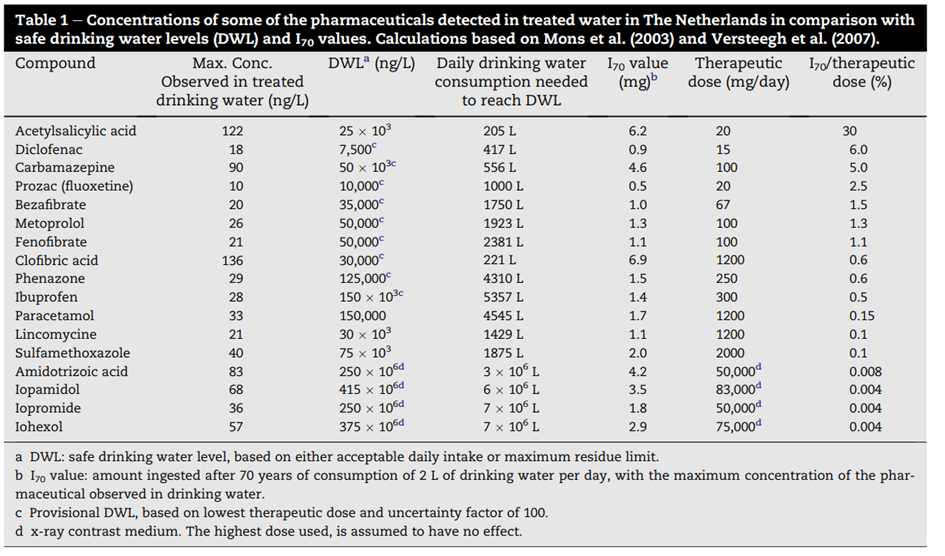
An example they cite for this is medication. They indicate that even though they are newly found in the water, the concentrations are very low. Afterwards threshold values are set, and these turn out to be much higher than the concentrations in our drinking water. The first column is how many ng/L (nanograms per litre) of the medication was found in the water. The second column is the threshold values for safe drinking water (the therapeutic dose (how much you would have to take as a patient to get the desired effect) divided by an uncertainty factor of 100). If we take carbamazepine (a medication against nerve pain) as an example:
Some 90 ng/L of carbamazepine was found in the water. 1 Ng/L equals 0.001 microgram(ug)/L, or 0.000000001 gram. You would have to drink 556 litres of water in a day to reach the threshold. Even if you drank water with 90 ng/L carbamazepine your whole life, you would come to a total dose of 4.6 mg, which is 20 times lower than the therapeutic dose that you normally get in 1 day of this medication.
In addition, they state that for pesticides the limit (per pesticide) was once set at 0.1 ug/L. The justification was that it does not belong in the water anyway, so it has to come out. However, we could not measure lower concentrations than 0.1 ug/L, so that became the limit.
“This value was based on the principle of ‘non-detectability’: the philosophy was that pesticides do not belong in drinking water and thus should not be present in it. As the limit of detection at that time was 0.1 mg/L, this became the standard.”
Then you can say: “you see! So we do not even know for sure whether that is safe.”
However, the same applies here as with lead. If you compare this with the amounts we take in via food, this is negligible.
Pesticides: For individual pesticides a uniform standard value of 0.1 ug/l is applied and 0.5 ug/l for the sum.
If we look at the report of the Pesticide Action Network (PAN), we see that per pesticide between 0.02mg/kg to 40.00 mg/kg is found on fruit and vegetables. This is between 20ug to 40,000 ug per kilogram. Put this against the 0.5 ug per litre of drinking water and you see how negligible that is.
For all ‘other anthropogenic substances’ a total threshold value of 1.0 ug/L has been set, in which genotoxic chemical substances (which cause DNA damage) have a threshold value of 0.01 ug/L and steroid hormones (such as testosterone or cortisol) a threshold value of 0.1 ug/L.
“The target values for individual genotoxic and steroid endocrine chemicals were set at 0.01 ug/L. For all other organic chemicals the target values were set at 0.1 ug/L. The target value for the total sum of genotoxic chemicals, the total sum of steroid hormones and the total sum of all other organic compounds were set at 0.01, 0.01 and 1.0 ug/L, respectively.”
These are based on the Threshold of toxicological Concern (TTC). As I showed earlier, threshold values are calculated for substances in REACH, but apparently not all substances are included in it, or there is not enough information about them at all. So here in the Netherlands they used the TTC. TTC is a threshold value that has to ensure a negligible risk for humans. The risk assessment in which the data of other substances and the exposure to the substance without data are weighed against each other. It was developed earlier for food and is used to set threshold values on the basis of data that we have on similar substances.
TTC has three categories based on the toxic effects of 613 substances: cramer class 1 (1,800 ug per person per day), cramer class 2 (540 ug per person per day) and cramer class 3 (90 ug per person per day). Where, for example, class 1 stands for substances that can easily be processed by our body and therefore have low oral toxic effects and class 3 are substances that on the whole may not be called safe at all. Meanwhile, substances have been classified separately, next to the three main classes, because they turned out to be even more toxic than other substances, such as aflatoxins (which grow in moulds) that are heavily carcinogenic and therefore got a threshold value of 0.15 ug per person per day.
Threshold values drinking water ‘other anthropogenic substances’ on the basis of TTC
To calculate threshold values it is taken into account that drinking water is not the only source of the substance. If there was uncertainty about this, they assumed that 10% of the total daily intake comes from drinking water (this is, for example, much higher than the 1% of the total intake of lead). It is calculated for someone who drinks 2 litres in a day and weighs 60kg, and then you get the following threshold values: 0.01 ug/L for genotoxic substances and 0.1 ug/L for all other substances.
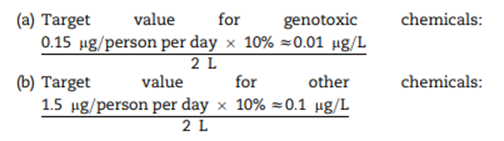
However, these scientists also realise that a mix of different substances could also cause problems for our health. For this the sum of all ‘other anthropogenic substances’ has been set at 1 ug/L. This is based on Concentration Addition (CA), in which substances that take the same toxic route in our body (toxic mode) are taken together. Therefore all possible substances in our water are categorised by toxic mode, so that substances that could reinforce each other's effect are taken into account as conservatively as possible. The authors state that this is a point of attention that needs more research and therefore a threshold value as low as possible has been set.
The threshold values are used by drinking water companies to guarantee water of good quality that you can drink your whole life. The fact that substances are present in our drinking water down to nanograms does not say something about the quality of our drinking water but about how ridiculously good our measuring instruments are. Which are used daily to check the quality of the drinking water.
The end
That was it then. My last dive into tap water. If you have read the whole blog, hats off! What I took from this blog you can read in the 4 lessons (summary). Again, I am not going to tell anyone whether or not to buy a water filter. I hope in any case that I have been able to put the claims that sellers of water filters make into some context. I am only too happy to hear whether I went wrong somewhere! I like to correct myself and see making mistakes as a learning moment. So bring it on!
What did you think? Let me know in the form of a comment or an email: [email protected]
Have you come across a claim on the internet or social media and are you curious about an assessment of the justification, let me know and I will dive in!
Do you want to support me and my nutrition science adventure? Share my articles or the podcast on your socials!
Everything you read on this website is my opinion based on knowledge and experience. Chances are that I sometimes overlook something, or that something could be better. I would love to hear it! We do science together.
Follow me on:
Instagram: https://www.instagram.com/coenfirmation_bias/
Linkedin: https://www.linkedin.com/in/coen-dros/