
35 min read
The science behind the scoop (pre-workout)
Pre-workouts are extremely popular. They are said to give you extra focus and help you get everything out of your training sessions. These multi-ingredient supplements often contain the same ingredients, but in different doses, often come with health claims and are said to be based on science. I use them sometimes too. That is why I wrote my first blog about them: about the pre-workout from Upfront. I concluded that the claims were often a bit of a stretch based on the science that was cited, and that there were a lot of catches. Now, almost 4 years later, there is a new pre-workout from Upfront, and I wondered: is the pre-workout now more in line with the science? And not only that: what about pre-workouts from other well-known brands in the Netherlands, such as Joel Beukers, XXL Nutrition, KRB and Kosso Nutrition? Let’s take a dive into the scientific support behind the “extra scoop”.
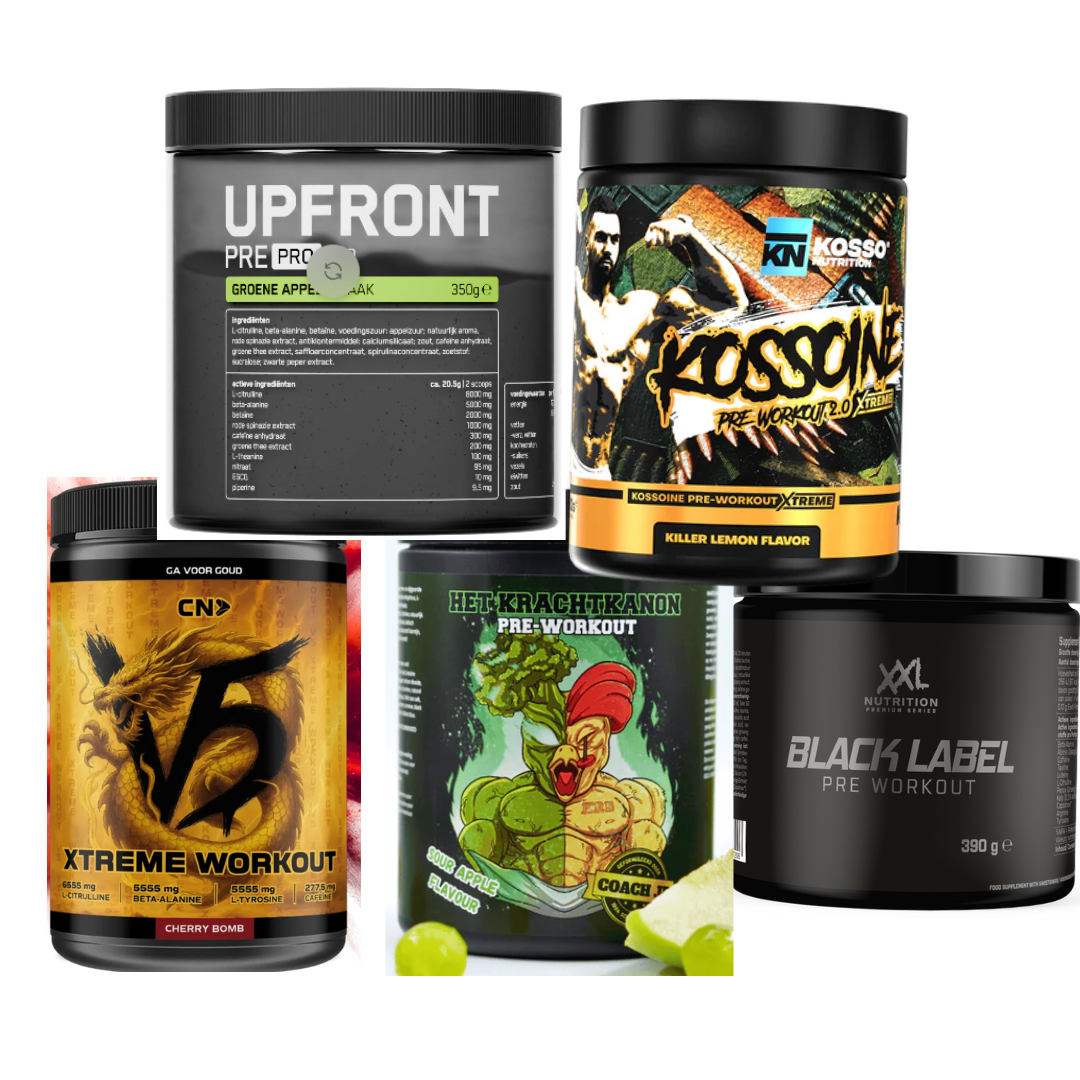
Three years ago I wrote my first blog. It was about the pre-workout from Upfront. Back then, Upfront was still a lot smaller on social media, focused mostly on misleading claims by other producers, and I was a fan! They launched their pre-workout together with scientific studies, placed on their website. That caught my interest, partly because I was using pre-workout myself too. So I took a dive into the claims about the pre-workout and the studies they cited for them. I was fairly critical in my blog and concluded that their claims were not entirely in line with the studies that were cited. Upfront appreciated this. I got a substantive reply, and since then they have always been very positive towards my science-check work. I value that, because in the years since I have met few people with the same mindset. Most people ignore and block my substantive criticism.
Now Upfront has launched the Upfront Pre 3.0, and I wondered: are the ingredients more in line with the science this time? So it is time for an update! I am also very curious how other pre-workouts in the Netherlands do. Also because several of them state that the pre-workout is scientifically supported.
Kosso Nutrition: "The strongest and most extreme pre-workout in the Netherlands with a scientifically supported formula!"
KRB: "The Krachtkanon from KRB is a scientifically supported sports supplement with an optimally balanced formula for maximum strength, focus and pump."
That is why I am going to discuss the most commonly used ingredients in pre-workouts and the science behind them. Put on your diving mask!
The new ingredients (among others) of the Upfront Pre pro 3.0:
| Old | New |
|---|---|
| 3000 mg L-citrulline dl malate 2:1 | L-citrulline 8000 mg |
| 3000 mg L-arginine alpha-ketoglutarate | – |
| 1900 mg Beta-alanine | 5000 mg beta-alanine |
| 1000 mg taurine | – |
| 230 mg caffeine | Caffeine anhydrous 300 mg |
| – | Betaine anhydrous 2000 mg |
My own bias
It is always good to state what my bias is towards this subject. I sometimes use a pre-workout myself. Although I do not really know whether it is mainly the caffeine that helps, or the other ingredients too. I also have products from Upfront at home. I have a good relationship with the owners of Upfront. I have not accepted any free products from the brands in this blog.
Health claims
In the old blog I also wrote a critical piece about the legislation on health claims. It does not encourage applying for health claims, because it is a very long and difficult process that costs a lot of money and gives a company little advantage, since your competitors are allowed to use the claims in the end too. That aside, I like to look at the scientific support that sellers of pre-workouts do have, so that I can inform myself and you well about the possible benefits. Only caffeine has an official health claim. This is officially recognised by the EFSA as promoting alertness and sports performance. All health claims you find on websites about other nutrients are therefore illegal, but that does not mean there is no scientific evidence for them.
I approached all the sellers I am going to discuss here and asked whether they would share the scientific support for their pre-workout with me. Since I do not do this for payment, it is legal for me to show the support. My blog was therefore a nice opportunity for them, if I say so myself, to advertise the pre-workouts – without the NVWA coming after them. While I was writing my old blog, there were in fact studies listed with the pre-workout from Upfront. I warned them at the time, but after not listening, they received a fine from the NVWA (I did not report it back then). For this blog, Upfront, Kosso Nutrition and KRB all replied positively and in substance to my questions. Upfront and KRB shared their support with me.
Responses from Upfront, KRB and Kosso Nutrition
For the blog I contacted five providers in the Netherlands: Upfront, Kosso nutrition, KRB (kiprijstenbroccoli), XXL nutrition and Clean nutrition. Upfront, Kosso Nutrition and KRB responded positively and read along with the blog. Where possible I have included their responses.
Upfront pointed me to the website of the Australian sports commission. This government organisation in Australia has a nice, clear website with factsheets on nutrients that (possibly) help with sports performance. I will put their advice next to my conclusions for the ingredients I discuss.
KRB pointed me to their Krachtkanon guide, which contains a list of literature for the choices of their ingredients. I will include this in the blog. Kosso Nutrition said they are working on a new pre-workout with a new formula (it will only be released early next year, so I will not include it in the blog), but that I had initially used the wrong dose in the blog. I had used 1 scoop, but they recommend 2 scoops. They deliberately kept the caffeine content a bit lower in 1 scoop, so that “pros” can take two scoops. They did not provide any literature.
Response from Upfront
“Literature on pre-workouts is always difficult of course, because there is no literature for your own specific formula, only for the single ingredients. So it feels more like a kind of literature puzzle with logical thinking to give the best possible result. We ourselves kept the focus on vasodilation and fluid retention in combination with caffeine of course. Vasodilation of course through the NOS pathway with L-citrulline, oxystorm/nitrates for the NO3-NO2-NO pathway and also polyphenols that can activate eNOS.
We chose these active ingredients so that we have a combination of fluid retention and better blood flow.”
I have included other parts of the responses in the blog
Kosso Nutrition
"In February our renewed and improved version will be released. The one we have now was released 3 years ago. We were the first brand in NL to really turn the doses up and to use pure L-citrulline (6 grams) instead of the underdosed citrulline/malate mix that the rest had. Back then this composition was unheard of in NL, but now we have learned a bit more and we are coming with an even better version."
The formula of the new version has not been shared with me.
KRB
“The krachtkanon guide states exactly which studies we used and what the possible value and mechanism of each ingredient could be, including scientific references regarding the possible mechanism, and so why we chose it. (These are not direct claims about our product, but references to studies that show which substances could do what, of course with the idea that this will differ per person"
KRB did reply extensively and in substance, but I am not allowed to share this with you. The formula is aimed, among other things, at NO production and so at giving a good pump. The product developer at KRB has his own reasoning and support for the formula. They do not want to share this because of competitors on the market. The support for the pre-workout that they gave me did not make me doubt the current content of the blog.
For the blog I used the following doses:
Upfront 3.0: 2 scoops (20.5 grams)
Kosso Nutrition killer lemon workout extreme 2.0: 2 scoop (36 grams)
Cleannutrition Xtreme workout V5 high stim: 1 scoop (25 grams)
XXL black label: 1 scoop (13 grams)
KRB krachtkanon: 1 scoop (20.8 grams)
Summary/conclusion
Let me get straight to the point. There is a good body of evidence for many of the ingredients added to pre-workouts. Ingredients such as citrulline, beta-alanine, betaine and caffeine have been studied for their positive effects on sports performance for some 20+ years. A combination has emerged of plausible biological mechanisms (how they work) that have been tested in studies with humans/animals and experiments with humans to test whether these mechanisms also really show up in better sports performance. And that is perhaps not so strange, since discovering ingredients that are not classed as doping but do give benefits is a nice option for (professional) athletes to improve their sports performance. As a result, a lot of time and money has been put into researching these ingredients.
For example, taking citrulline leads to higher arginine levels, which in turn leads to a greater production of nitric oxide and faster clearing of waste products in muscles. This leads to better endurance and less muscle fatigue, with the result that you can do extra reps in the gym. Taking beta-alanine leads to higher carnosine levels, which in turn counters muscle acidification, and so you can exercise for longer. Caffeine blocks the effect of adenosine, which leads to more alertness and better sports performance, and betaine has an important role in the methylation cycle, so that it leads to more endurance and thereby helps you do more reps in compound exercises such as squats.
This is a bit of a stretch, so if you want to read more about this, do keep reading! But these claims are supported by experiments with humans. There are, however, important nuances that need to be added. They work in different ways and possibly not the same for everyone. These are nuances that are missing in the communication around pre-workouts, but are crucial for the positive effect they could have on your workout. Let me divide them into three important points:
1. Acute versus chronic
Which supplement protocol do you use? The pre-workout is known for being received with open mouth, after which you jump into the weights. But what do you do if you have no workout?
For some ingredients the effect is acute. For example, citrulline and caffeine work when you take them in a (relatively) high dose right before the workout that follows. Pre-workouts are also often advised to be taken before a workout, which is no surprise when you call it “pre-workout”. This does not hold for all ingredients, though. Beta-alanine and betaine work only after you have taken them for a longer time. Often every day for weeks. And no, the tingling feeling from beta-alanine does not lead to a better workout. So if you train 3 times a week and take your pre-workout only then, you do not get all the benefits you could get from it and that you are paying for.
2. Dose and timing
Another crucial point in your supplement protocol is the dose and timing of intake. Saying that citrulline leads to the production of arginine and thereby to more nitric oxide production says nothing about how much citrulline you should take and when. When we bring in the scientific studies, we see a clear pattern. There are specific doses (number of grams) that are used at a specific time or (number of) moments. Together, that leads to the positive effects. Pre-workouts do not seem to take this into account. All ingredients are taken at the same moment in a standard dose, while all ingredients actually need different protocols. Not to mention that the doses are not always sufficient. It is not always clear whether that leads to no effect, but it is in any case not in line with the literature.
3. Individual differences
And then finally we have individual differences. An important difference is the one between men and women. Those bodies do not work in the same way, so baseline levels (that is, how much of a certain substance is already in your body before you supplement it) differ. This plays a role for carnosine (women have less of it), for example, and in the processing of betaine. Unfortunately, most studies in sports science are done with men, so little is known yet about the relevance of these differences.
Another important factor for your baseline levels is your current diet. Many of the substances in pre-workouts are substances that are in our normal food. Another big individual difference is size. Some people are a lot heavier and bigger than others. The best-studied ingredient – caffeine – takes this into account. You should supplement at least 3 mg per kg of body weight. You just cannot tailor this to yourself with a pre-workout. For the other ingredients, too little research has been done to be able to recommend such a specific dose. If you do not take this into account, a supplement may be more or less useful for you.
If I have to summarise it in a table, it looks as follows for the most important ingredients:
Green = good, orange = doubt, red = not good.
Table 1: dose of ingredients compared with recommended dose (top row).
| Brand | Citrulline (5.3 grams) | Beta-alanine (5.6 to 6.4 grams)* | Caffeine (3 mg per kg of body weight) | Betaine (2.5 grams) |
|---|---|---|---|---|
| Upfront | 8 grams | 5 grams | 300 mg** | 2 grams |
| Kossonutrition | 12 grams | 6 grams | 500 mg** | 2.5 grams |
| Cleannutrition | 6.5 grams | 5.5 grams | 277.5 mg** | 1.5 grams |
| KRB | 6 grams | 3.5 grams | 263 mg** | 1.75 grams |
| XXL | 2 grams | 2.5 grams | 330 mg** | - |
*The most recent review focused on strength training gives a minimum dose of 5.6 grams. Earlier reviews, also focused on endurance sports, gave 3.2 as the minimum dose. That is why I used orange.
**Correction: because of possible concerns about the high dose of caffeine, I changed the colour from green to orange. The EFSA advises against doses higher than 200 mg at a time or 400 mg over the day for the general healthy population. The International society of sports nutrition advises against doses higher than 9 mg per kg of body weight for athletes. This is because of side effects such as headache, tremors, dizziness, ringing in the ears and heart palpitations.
Table 2: timing of ingredients compared with recommended timing (top row).
| Brand | Citrulline (60 min before workout) | Beta-alanine (at least 200 grams in 4 weeks) | Caffeine (right before workout) | Betaine (2 weeks) |
|---|---|---|---|---|
| Upfront | 15 – 30 min | 15 – 30 min | 15 – 30 min | 15 – 30 min |
| Kossonutrition | 15 – 30 min | 15 – 30 min | 15 – 30 min | 15 – 30 min |
| Cleannutrition | 15 – 30 min | 15 – 30 min | 15 – 30 min | 15 – 30 min |
| KRB | 15 – 20 min | 15 – 20 min | 15 – 20 min | 15 – 20 min |
| XXL | 30 min | 30 min | 30 min | 30 min |
The pre-workout from Kosso Nutrition is by far the highest dosed. So high that with 500 mg, caffeine can cause side effects for people lighter than 80 kg (I understand the new formula will contain less caffeine). For most pre-workouts and ingredients it is not the height of the dose that is the problem. It is the advice on how a pre-workout should be taken that is not effective, but the advice is almost the same from every seller (I do not know why). The ingredients actually just call for a different approach: a pre-workout with ingredients with acute effects and a supplement with ingredients you can take daily to support your workouts.
Do you want to learn more about each ingredient and how best to take it? Then do keep reading! In every conclusion you will find the scientifically supported dose and timing (if there is one). I also cover a few extra ingredients.
Citrulline
The theory: L-citrulline is an amino acid that plays a central role in the body in the production of nitric oxide (NO). After intake, L-citrulline is converted into L-arginine, which increases NO synthesis. More NO causes vasodilation (widening of the blood vessels), which improves blood flow, so that oxygen and nutrients are transported to the muscles more efficiently during exertion. This would result in improved training performance, increased endurance and faster muscle recovery. In addition, L-citrulline affects the removal of ammonia and other waste products from the muscles, which would help delay muscle fatigue. Malate is usually added in a 2:1 ratio. Malate is a biochemical intermediate and a salt or ester of malic acid. In the body, malate plays a central role as part of the citric acid cycle (also called the Krebs or tricarboxylic acid cycle), in which it helps produce energy in cells from fats and carbohydrates. Malate might possibly promote the uptake of citrulline and energy production.
But however interesting theories about mechanisms are, we want to see whether this really works in humans. In the previous blog I therefore focused on the study by Varvik et al. (this was in the narrative review that Upfront cited and was the strongest evidence I could find). I could not find a more recent systematic review.
Varvik et al. Acute Effect of Citrulline Malate on Repetition Performance During Strength Training: A Systematic Review and Meta-Analysis. (2021)
Varvik et al. carried out a systematic review and meta-analysis to investigate whether supplementing citrulline before strength training can increase the total number of repetitions of lower- and upper-body exercises to muscle failure in healthy adults.
In short, Varvik et al. found the following: a total of eight randomised controlled trials containing fourteen exercises, consisting of exercises that work single muscle groups (for example biceps curls) or multiple muscle groups (for example leg press), with an average of 51 repetitions and 5 sets at 70% of maximal strength per repetition. So if you can lift 100 kilos for 1 repetition, the exercise is done with 70 kg. Supplementing 6 to 8 grams 40 to 60 minutes before the exercise significantly increased the number of repetitions (p = 0.022) by 3 repetitions (6.4%) compared with the placebo group, with an effect size of Hedges’ g = 0.196 (95% CI ). When separate analyses were done for lower- and upper-body exercises, the results were weaker. The number of repetitions for the lower body increased by 8% with borderline significance (p = 0.051) and the number of repetitions for the upper body by 6%, but not significantly (p = 0.131), compared with the placebo group. One study (of the eight) used 6 grams (Da Silva et al.) and one study (of the eight) administered citrulline 40 minutes before the training (Gonzalez et al.). Both studies showed no significant effect of citrulline on the number of repetitions, and Gonzalez et al. even showed a non-significant negative effect (Hedges’ g –0.072 [–0.320 – 0.324]). It therefore seems correct to me to claim that 8 grams and 60 minutes before the workout in particular is the effective dose. Finally, the positive effect was mainly found in the groups with exercises that worked multiple muscle groups, such as the bench press, and that did lower-body exercises, such as a leg press.
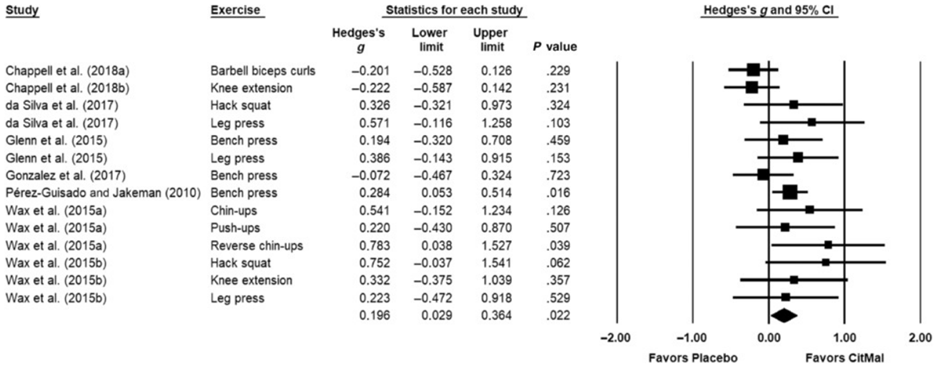
The authors conclude that supplementing citrulline malate before a strength training session can lead to a small increase in repetitions. Even though the effect size is small, supplementing citrulline could lead to an important increase in training volume and thereby improve sports performance.
“The main meta-analysis resulted in an increase of 3 ± 5 weighted repetitions in the Citrulline Malaat condition compared with the placebo condition.”
So this study confirms the positive effect of citrulline malate (2:1) on strength sports performance. Besides this review, which I received earlier from Upfront, I also received a substantial document with studies from KRB. In it you find the chapter “citrulline, malate and citrulline malate” with a reference list. I mainly focus on studies with humans and sports performance outcomes, and not already included by Varvik et al. (which is also in the literature list).
Valaei, Kosar et al. Effects of L-citrulline supplementation on nitric oxide and antioxidant markers after high-intensity interval exercise in young men: a randomized controlled trial. 2017.
Valaei et al. is the only study that investigated citrulline in isolation, although they did not look at sports performance. They investigated nitric oxide and antioxidant markers in the blood after an intensive workout. Nine young men received 12 grams of citrulline or a placebo one hour before their workout. Blood was taken immediately and after 10 and 30 minutes. This showed that taking citrulline led to improvements in both nitric oxide and antioxidant markers. This could lead to better recovery from a workout, but that direct link was not made in this study.
After that, several other studies are cited that investigated the effect of citrulline malate on sports performance. The results are inconsistent, though. For example, after supplementing 12 grams of citrulline malate (no ratio stated) 60 minutes before a workout, Cunniffe et al. found no effect on sports performance during cycling. Environ-Lanpier et al. gave participants 4.4 grams of CM (ratio unknown) 60 minutes before a CrossFit workout. They saw no improvement in sports performance, except that the group stayed 5 seconds longer in zone 4 (heart rate) after taking CM. Participants in the study by Varia et al. had a slightly faster sprint time after supplementing 8 grams of CM (ratio unknown) spread over 8 moments of 1 gram over the day (for 3 days). And the last new study I came across in the literature list was that of Gills et al., in which women (who were in the first phase of their menstrual cycle) saw an improvement in leg extension exercises after supplementing 8 grams of CM (ratio unknown).
Cunniffe, Brian et al. Acute Citrulline-Malate Supplementation and High-Intensity Cycling Performance (2016)
Evrim-Lanpir, Asli et al. “Effects of Acute Citrulline Malate Supplementation on CrossFit® Exercise Performance: A Randomized, DoubleBlind, Placebo-Controlled, Cross-Over Study. (2024)
Varia, Vinicius S, and Brendan Egan. Effects of 3 days of citrulline malate supplementation on short-duration repeated sprint running performance in male team sport athletes. (2024)
Gills, Joshua L et al. Acute Citrulline-Malate Supplementation Increases Total Work in Short Lower-Body Isokinetic Tasks for Recreationally Active Females During Menstruation. (2023)
When I look at the body of evidence on citrulline malate supplementation like this, something interesting is going on. It is namely not at all clear what the role of malate is in relation to sports performance. When I went looking in the individual studies for the supplement they used, only one study reports the dose of citrulline versus malate (instead of only mentioning 8 grams of citrulline malate). Chappell et al. reports using a CM supplement with a ratio of 1.1:1 (4.2 g citrulline and 3.8 g malate), which would thus be lower than the usual 2:1. This just happens to be the study with the worst result (trend: decrease in number of repetitions) in the meta-analysis. For all the other studies it is unclear which ratio was used. I have also not seen any studies anywhere that investigated malate alone.
In addition, citrulline in isolation has been studied, which shows that in particular 6 to 12 grams of acute supplementation 1 to 2 hours before the workout possibly leads to improvements in both endurance and strength sports. Recently, Bayat et al. showed that when groups of strength athletes consumed 8 grams of pure citrulline or 12 grams of citrulline malate (2:1) before exercising, the positive effect was equally large. Finally, there is also evidence that up to 15 grams of citrulline is effective for raising citrulline in the blood.
Moinard et al. Dose-ranging effects of citrulline administration on plasma amino acids and hormonal patterns in healthy subjects: the Citrudose pharmacokinetic study. (2008)
“Finally, the pharmacokinetic parameters suggest that saturation begins to occur at a load of 15 g, and therefore a 10 g dose should be the most appropriate for use in clinical practice.”
When I dig deeper, it seems that the combination of citrulline and malate was once sold as a medicine (patented under the name Stimol) for people with asthenia (general weakness) after illness. In the 80s, two studies are said to have found positive effects on endurance and recovery in these patients. However, the studies by Creff and Dauverchain cannot be found by me. So it is not clear to me where the 2:1 ratio and the reason for adding malate come from.
It seems in any case that you want to supplement at least 5.3 grams of citrulline (based on 8 grams of citrulline (5.3 g) malate (2.7 g) in a 2:1 ratio), but preferably dose higher. But again, the literature is not clear about which ratios were used in studies. This creates uncertainty about what the minimum and optimal dose is, and what the role of malate is in the improvements in sports performance.
Upfront has chosen no longer to go for a combination of the two, but to focus on citrulline only. They have raised the dose of citrulline, so they no longer needed to top it up with arginine (in the old blog you can read why they had chosen that). The dose of citrulline (8 grams) is now high enough to achieve the desired effect. After reading my blog, Upfront also said that they could not find studies on the importance of malate and therefore left it out. It is important, though, that the pre-workout is taken 60 minutes before training. This does not match the advice of taking it 15 to 30 minutes before the workout that is now on the packaging of the Pre Pro 3.0.
Gough et al. A critical review of citrulline malate supplementation and exercise performance. (2021)
Nabari et al. Overview of mechanisms related to citrulline malate supplementation and different methods of high-intensity interval training on sports performance: A narrative review. (2025)
“Further research examining temporal changes in citrulline concentration after CM supplementation is needed to determine the optimal strategy, although the best recommendation is currently 1 h before exercise.”
Other brands
Kosso Nutrition
The Killer Lemon Extreme pre-workout from Kosso Nutrition contains 12 grams of citrulline and 3 grams of malate. That is a citrulline malate ratio of 4:1. The pre-workout is advised to be taken 15 to 30 minutes before a training session.
Clean Nutrition
The Xtreme Workout V5 – High Stim from Clean Nutrition contains 6.5 grams of citrulline and no malate. The pre-workout is advised to be taken 15 to 30 minutes before training.
KRB
The Krachtkanon from KRB contains 6 grams of citrulline and 2 grams of malate. The pre-workout is advised to be taken 15 to 20 minutes before training.
XXL
The Black Label pre-workout from XXL contains 2 grams of citrulline and no malate. They do add arginine (1 gram). The pre-workout is advised to be taken 30 minutes before your training.
Conclusion Citrulline
The body of evidence for strength sports has so far mainly focused on a combination of citrulline and malate and to a lesser extent on citrulline in isolation, with a dose of 8 grams in total (ratio 2:1, that is 5.3 grams of citrulline and 2.7 grams of malate) seeming to be the minimum. There are question marks about this ratio, though: is this really what studies used? And how important is the role of the ratio with malate, or of malate on its own? That has not been reported and studied well. There are indications (also based on studies with endurance sports) that the greatest effect comes from citrulline and that on its own in a high dose (6 grams+) it is (more) effective.
So it seems that replacing arginine with citrulline and raising the dose to 8 grams is a fine choice by Upfront. It is not certain whether a combination of citrulline and malate would have been a better choice. All the brands have approached this differently, with all brands except XXL in any case adding the minimum 5.3 grams of citrulline. None of them keeps to the 2:1 ratio with malate. It is not clear what the reason for this is and to what extent this is a good choice. It does seem, though, that the more citrulline, the better. That is why the pre-workout from Kosso Nutrition, with 12 grams of citrulline, is the best dosed. XXL did add arginine. This resembles the old formula of Upfront. This choice is made because the ultimate goal is to raise arginine in the blood for the positive effects. A disadvantage is that more arginine is broken down in the gut and is therefore less effective. The combination does seem to improve uptake (see old blog), but little research has been done on this combination in humans.
Good to bear in mind is that some studies report stomach complaints in 15% of participants. (1) (2)
The advice to use it about 15 to 30 minutes before training is not optimal. Almost all (effective) studies use 60 minutes before training, since citrulline needs at least 40 minutes to peak nitric oxide (NO) production in the blood. This is important, since the aim of using citrulline malate is mainly an acute effect (the effect of the supplement on the workout directly after it).
Citrulline (malate) is not on the supplement list of the Australian sports commission.
Beta-alanine
The theory: beta-alanine is a non-essential amino acid. When you take it as a supplement, it raises the carnosine content in your skeletal muscles. Carnosine acts as a buffer: it captures hydrogen ions (H+) that are released during intensive exertion. This slows the drop in pH (acidification) in the muscle. Through this buffering you might be able to perform for longer at (very) high intensity before fatigue sets in. Carnosine is broken down by enzymes, which makes it not useful to supplement, and beta-alanine could therefore be a perfect solution. But here too the question is: does this mechanism really show up in humans? I found a fairly recent one from 2025 that is a nice addition to the review I discussed in the previous blog. Let us first look at the old review.
Saunders et al. β-alanine supplementation to improve exercise capacity and performance: a systematic review and meta-analysis. (2017)
Saunders et al. carried out a systematic review and meta-analysis in which they investigated the effect of beta-alanine supplementation on exercise capacity and sports performance.
In short, Saunders et al. found the following: a total of 40 studies with more than 65 exercises (ranging from swimming to cycling to strength training, really everything) with in total more than 1400 participants. Sports capacity is defined as endurance (that is, how long until exhaustion) and sports performance as how high or how far someone jumps/swims/runs etc. When all studies are pooled, beta-alanine has a significant small beneficial effect on sports performance (both capacity and performance) (Morris = 0.18; 95% CI: 0.08 – 0.28). This effect is significantly influenced by the duration of the exercises, but a sub-analysis also shows that the largest effect is on sports capacity (0.4998; 95% CI 0.246 to 0.753).
The authors conclude that beta-alanine has a significant beneficial effect on sports performance (both capacity and performance), but that many factors influence this effect. One of these factors is the combination with sodium bicarbonate (baking soda). In a sub-analysis this showed the largest result (Upfront said in a reply to the old blog that you have to supplement fairly large amounts, some 40 grams for someone of 75 kg, which makes it impossible to put that in the pre-workout).
Still, a few things stand out when you dig deeper into the meta-analysis. For example, there was no significant beneficial effect of beta-alanine when people exercised for longer than 10 minutes. This suggests that the positive effect on acidification is mainly in the first 10 minutes. In addition, the authors state that supplementing 1.6 grams per day for at least 2 weeks already leads to raised carnosine levels, but that effects on sports performance are only really seen at 3 to 6 grams per day for at least 4 to 12 weeks. The authors advise athletes to supplement 3.2 to 6.4 grams per day for at least 2 to 4 weeks, at different moments of the day (0.8 to 1.6 grams every 3 to 4 hours), to prevent negative effects (tingling).
“Individuals are advised to supplement daily with β-alanine for a minimum of 2–4 weeks at a dose of 3.2–6.4 g/day ingested at several time points throughout the day (0.8–1.6 g every 3–4 hour) to avoid acute side effects.”
The results of Saunders are underlined by a more recent systematic review by Ong et al., which focused only on strength training.
Ong et al. Dosing strategies for β-alanine supplementation in strength and power performance: a systematic review. (2025)
The authors of this review looked mainly at studies with strength sports, whereas the previous review mainly included endurance sports. They conclude that the way you take beta-alanine is crucial to see an increase in strength:
- Splitting doses (e.g. 0.8 g spread over several moments per day) is more effective than large single doses or slow-release capsules to improve strength and power.
- Cumulative dose (total amount of beta-alanine per study period) is more important than the duration of intake alone: beneficial effect at a total dose of ≥ 200-300 g.
In other words, optimal supplementation consists of 3.2 to 6.4 g of beta-alanine daily, divided into small doses, for 5-8 weeks. This is the way to raise the carnosine content in the muscles optimally, so that your muscles acidify less quickly. Your body could namely absorb only a limited amount at a time and you just pee out the rest (see for example Goncalves et al. Insulin does not stimulate β-alanine transport into human skeletal muscle. (2019)).
The interesting thing is that in response to my first blog, Upfront said it added beta-alanine only because of the side effect (tingling).
Upfront: “The effect of Beta-alanine is slowly becoming beyond dispute through continuing research on performance-enhancing effect. Unfortunately, with a pre-workout that is not consumed daily we cannot achieve this beneficial effect. Next we looked at what characteristics/ingredients/sensations of a pre-workout are important for a consumer.”
They confirmed after reading the blog that they still believe athletes like to experience the tingling feeling. Which is fascinating, since the tingling feeling does not mean that it also really helps with exercise. For this reason too, KRB added beta-alanine, but acknowledges that it actually has to be supplemented daily.
The dose of beta-alanine has been raised considerably in the new version. The dose has more than doubled (from 1.9 grams to 5 grams) and is thereby within the advice for the optimal dose. But you only reach this with chronic intake of at least 40 days (= 200 grams). This means supplementing daily (in smaller amounts) for some 5 to 8 weeks. This is not feasible with the pre-workout, since you cannot spread the dose over several moments.
Beta-alanine is thus supplemented to raise carnosine in the muscles. This now has researchers looking at how people could supplement carnosine directly. If you want to read more about that, I recommend the blog by strongerbyscience.
Beta-alanine is also included in the literature list of KRB. Almost all individual studies in the list were included in the reviews by Saunders et al. and Ong et al. There was, however, a nice recent review in it that focused mainly on explosive sports and young men.
Georgiou et al. Effect of Beta-Alanine Supplementation on Maximal Intensity Exercise in Trained Young Male Individuals: A Systematic Review and Meta-Analysis. 2024.
“The duration of beta-alanine supplementation showing the greatest ergogenic benefits was 4 weeks, with the administered dosage ranging from 5.6 to 6.4 g per day. Beta-alanine supplementation was most effective for exercise lasting 4–10 min… Supplementation is likely to be most beneficial for athletes in high-intensity sports lasting from 4 to 10 min, such as middle-distance runners, rowers, swimmers, and combat sports’ athletes.”
Here, too, Georgiou et al. emphasise that chronic intake (at least 4 weeks daily) of a high dose is important to bring about a small positive effect in the first 4 to 10 minutes of the workout. They propose a dose of at least 5.6 grams per day. Which is much higher than the dose KRB itself uses in their pre-workout. Which you can call strange, to say the least.
Interesting to mention is that Georgiou et al. deliberately excluded women from the study. They did this because women would naturally have lower carnosine levels. Since carnosine plays the critical role in the mechanism for sports performance improvements, this could influence the results. And then I have to think of citrulline, since I wrote there in my previous blog that baseline blood levels (how much you already have in your blood at the moment you start supplementing) can have a great influence on the effect.
Other brands
Kosso Nutrition
The Killer Lemon Extreme pre-workout from Kosso Nutrition contains 6 g of beta-alanine. The pre-workout is advised to be taken 15 to 30 minutes before a training session.
Clean Nutrition
The Xtreme Workout V5 – High Stim from Clean Nutrition contains 5.5 grams of beta-alanine. The pre-workout is advised to be taken 15 to 30 minutes before training.
KRB
The Krachtkanon from KRB contains 3.5 grams of beta-alanine. The pre-workout is advised to be taken 15 to 20 minutes before training.
XXL
The Black Label pre-workout from XXL contains 2.5 g of beta-alanine. The pre-workout is advised to be taken 30 minutes before a training session.
Conclusion beta-alanine
So it seems that beta-alanine can have a positive effect on your workout. This is also recognised by the Australian sports commission. They even place the nutrient in group A – nutrients with strong scientific evidence for use in sport.
“Beta-alanine supplementation increases muscle carnosine levels, boosting muscle buffering, delaying fatigue and improving performance.”
They propose a loading dose (3.2 to 6.4 grams for 4 to 8 weeks) to reach the 200 to 300 grams, and then to switch to a maintenance dose (1.2 grams per day). With finally the advice to spread it in smaller amounts (3 to 4 moments) over the day, together with a meal. This advice is missing from all the pre-workouts I have discussed. The advice to spread beta-alanine over 3 to 4 moments or over a loading and maintenance dose is not possible with the pre-workout, but you can at least calculate how many days you have to use it to reach the desired 200 to 300 grams for optimal effect. This will be shortest for Kosso Nutrition (33 to 50 days) and longest for XXL (80 to 120 days). The most recent review entirely focused on strength training among young boys gives a minimum dose of 5.6 grams. This is only reached by Kosso Nutrition.
The Australian commission also states that women probably have lower carnosine levels, so that they possibly have to supplement more. This has not been researched enough.
Caffeine
Then we come to the only ingredient with an approved health claim: caffeine. You may officially say that caffeine improves alertness (at at least 75 mg per serving) and improves sports performance (at at least 3 mg per kg of body weight). Caffeine improves alertness and sports performance by affecting several biological processes in the body. After intake, caffeine is absorbed quickly and distributed over all organs, including the central nervous system. There, caffeine blocks the effect of adenosine, a substance that normally causes sleepiness and fatigue. As a result, alertness, concentration and the feeling of energy increase, while the experience of fatigue decreases. During exertion, caffeine stimulates the nervous system further, which raises the production of stimulating neurotransmitters such as dopamine and noradrenaline. This leads to increased readiness of body and mind and a reduced feeling of pain and effort, which affects sports performance positively. There are also indications that caffeine directly affects muscle cells, so that strength and endurance may increase slightly, especially in endurance and strength sports.
In my old blog I also cited the consensus paper of the International Society of Sports Nutrition.
Guest et al. International society of sports nutrition position stand: caffeine and exercise performance. (2021)
The Australian sports commission also has it in group A, stating that caffeine is the best-studied substance for improving sports performance. The advice of these commissions together comes down to:
- Supplementation with caffeine has been shown to have an acute positive effect on sports performance. These are small to moderate benefits for muscle endurance, movement speed and muscle strength, sprint, jump and throwing performance, as well as a broad range of aerobic and anaerobic sport-specific actions.
- The most consistent moderate to large benefits are for aerobic endurance, but the size of the effect differs between individuals.
- 3 to 6 mg per kg of body weight is the sweet spot. 2 mg is the minimum and 9 mg causes unpleasant side effects. The Australian sports commission advises keeping it at 3 mg.
- Up to 60 minutes before exertion is usually best, but try not to take it less than 5 hours before your sleep.
- It works for both untrained and trained people.
- People can have a genetic predisposition for sensitivity to caffeine. This determines how much effect it has on exercise, but also how many adverse effects it has on sleep and/or feelings of anxiety. But tolerance (decrease of effect through daily use) is also an important factor.
- It leads to better cognitive function: better focus.
- It also works as a booster for endurance training in the heat or at altitude.
- Alternative sources such as chewing gum etc. also work.
- Energy drinks and other supplements with caffeine also work.
The dose of caffeine in the Upfront Pre 3.0 has been raised (from 230 mg of caffeine to caffeine anhydrous 300 mg). The difficult thing with caffeine is that you actually want to base the dose on a relative measure in relation to your body weight (3 to 6 mg per kg of body weight). A dose of 300 mg is therefore the minimum for someone of 100 kg and the maximum for someone of 50 kg, but as is also the problem with beta-alanine – you cannot dose well with a pre-workout. If you stick strictly to 3 mg, then 300 mg is really only a good dose for someone of 100 kg. As for timing, the advice to take it 15 to 30 minutes before your workout is good advice. But if you exercise in the evening, a pre-workout can have negative effects on your sleep. This is not mentioned.
Other brands
Kosso Nutrition
The Killer Lemon Extreme pre-workout from Kosso Nutrition contains 500 mg of caffeine (but is also available in a caffeine-free variant). I understand the new formula will contain less caffeine. The pre-workout is advised to be taken 15 to 30 minutes before a training session.
Clean Nutrition
The Xtreme Workout V5 – High Stim from Clean Nutrition contains 277.5 mg of caffeine. The pre-workout is advised to be taken 15 to 30 minutes before training.
KRB
The Krachtkanon from KRB contains 263 mg of caffeine (but is also available in a caffeine-free variant). The pre-workout is advised to be taken 15 to 20 minutes before training.
XXL
The Black Label pre-workout from XXL contains 330 mg of caffeine (but is also available in a caffeine-free variant). The pre-workout is advised to be taken 30 minutes before a training session.
Conclusion caffeine
Caffeine is a no-brainer as a pre-workout, but is still less suitable for a multi-ingredient pre-workout. It would be optimal if you could aim the dose at your body weight. With the consensus seeming to lie at 3 mg per kg of body weight. It could therefore be smart to choose a pre-workout whose caffeine dose is better matched to your body weight. Although how sensitive you are to caffeine can differ per individual. So try to make an estimate of that for yourself too. In addition, the pre-workouts are less suitable for people who exercise in the evening, because of the effect on sleep. For that, the caffeine-free option from Kosso Nutrition, XXL or KRB is a better choice.
Australian commission: “Time your caffeine intake away from sleep time, as half still remains in your system 5hrs after ingestion.”
Above 6 mg per kg of body weight you can get side effects sooner. This is especially the case with Kosso Nutrition, which is dosed very high. At a weight of 83 kg or lower you can get side effects such as headache, tremors, dizziness, restlessness etc. The timing advice of all the brands is fine, since you can use caffeine up to an hour beforehand and it acts very quickly.
Betaine anhydrous
There is also a new ingredient added by Upfront: betaine.
The theory: Betaine, also known as trimethylglycine, is a substance that plays an important role in the body in methylation processes and in maintaining the osmotic balance in cells. It is found mainly in beets, spinach and whole grains. After intake, betaine acts as a methyl group donor in the methylation cycle, where it helps convert homocysteine into methionine, an essential amino acid for many biological processes, including protein synthesis and cell growth. These are crucial for maintaining cell health and regulating gene expression. In addition, betaine functions as an osmolyte, which means that it regulates water balance at cell level. This helps protect cells against dehydration and stress, especially under conditions of increased physical load or dehydration, which matters during heavy exertion. Through these effects betaine might support muscle function, improve endurance and delay muscle fatigue. Betaine is often used as a sports nutrition supplement with the aim of improving performance. It would contribute to more efficient energy production and support recovery processes after exertion, among other things through an influence on protein synthesis and anti-inflammatory effects. This combination of methylation support and cellular hydration makes betaine a possibly useful substance in the context of sports performance and general bodily functions.
The only approved claim for betaine is “contributes to normal homocysteine metabolism”. This is achieved at a dose of 500 mg per serving and the effect is achieved at 1.5 grams of betaine. This is not a sports-related claim, though.
Zawieja et al. Effects of chronic betaine supplementation on exercise performance: Systematic review and meta-analysis. (2024)
The most recent and strongest study on the effect of betaine on sports performance that I could find is the one by Zawieja et al.
In short, Zawieja et al. found the following: a total of 17 studies with in total 317 participants (80% men, 20% untrained and mean age between 16 and 35) were included in the review. Most studies used a dose of 2500 mg, but one study used less (2000 mg). Most studies looked at various sports outcomes such as: vertical jump (8 studies), 1RM maximal muscle strength (upper and lower body in 5 studies), 1RM maximal muscle strength in squat (4 studies), muscle endurance and strength in the bench press (4 studies) and cycling sprint (peak and mean power in 4 studies). When all studies were pooled in a meta-analysis, the scientists mainly saw a significant improvement in vertical jump (, 95% BI) and maximal lower-body muscle strength (, 95% BI). There was no improvement for other outcomes such as upper-body muscle strength and muscle endurance or cycling sprints.
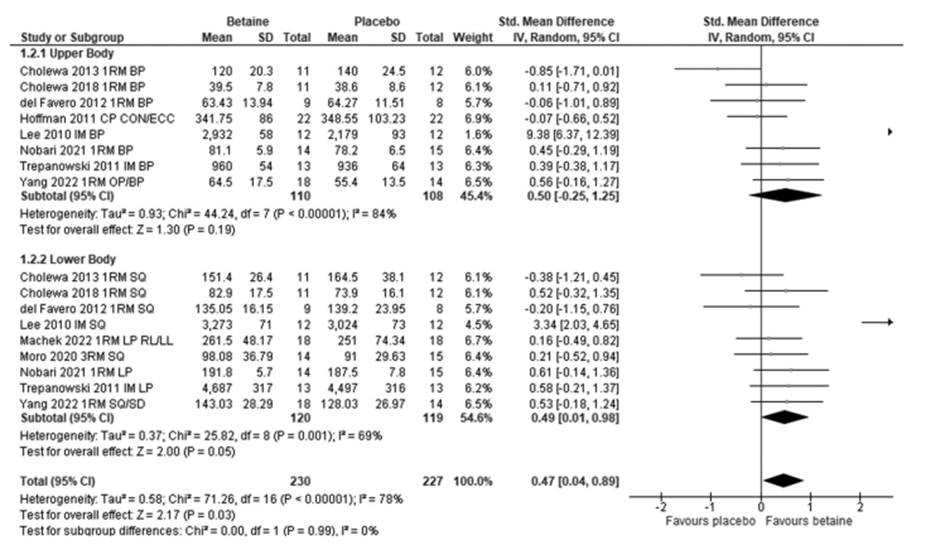
The authors conclude that they see the benefits of 2.5 grams of betaine mainly in exercises such as squats, leg press and sumo deadlift. “This effect was primarily driven by improvements in lower body strength, including measures such as 1RM in SQ, LP, and sumo deadlift. However, the effect on upper body strength did not reach statistical significance, although a sensitivity analysis revealed potential benefits when certain studies were excluded. These findings suggest that betaine may have a more pronounced impact on lower body strength compared to upper body strength.” I do want to mention here that the studies with lower-body exercises investigated chronic intake of betaine. At least 2 weeks and sometimes up to 14 weeks. With this ingredient too, it seems that benefits only come with daily intake over a longer period.
The interesting thing is that the authors of the review themselves carried out an experiment and published it in 2023. In it, two groups (2.5 grams of betaine and 5 grams of betaine) were asked to take betaine spread over the day for three weeks. They found a significant improvement in performing a CrossFit routine (8 extra repetitions). There was no difference between 2.5 or 5 grams of betaine, though.
Upfront chose to add 2 grams of betaine. The only study within this review that used 2 g saw an improvement in VO2max and sprint outcomes in young professional footballers (Nabari et al. Effects of chronic betaine supplementation on performance in professional young soccer players during a competitive. 2021). None of the studies focused on strength sports used less than 2.5 g. So it is not clear to what extent 2 g is sufficient for that.
The literature list of KRB contains no new literature. Here too, with betaine, there may be differences between men and women. Zawieja et al. state that future research should mainly focus on differences between men and women. For example, the metabolism of betaine would be different for women (due to a reduced betaine-homocysteine enzyme). It is not clear what the effect of this is on the sports-performance-enhancing effects for women.
Other brands
Kosso Nutrition
The Killer Lemon Extreme pre-workout from Kosso Nutrition contains 2.5 grams of betaine. The pre-workout is advised to be taken 15 to 30 minutes before a training session.
Clean Nutrition
The Xtreme Workout V5 – High Stim from Clean Nutrition contains 1.5 grams of betaine. The pre-workout is advised to be taken 15 to 30 minutes before training.
KRB
The Krachtkanon from KRB contains 1.75 grams of betaine. The pre-workout is advised to be taken 15 to 20 minutes before training.
XXL
The Black Label pre-workout from XXL contains no betaine.
Conclusion betaine
It seems that chronic supplementation of betaine can have positive effects on your workout, certainly when it concerns larger compound exercises on leg day or when doing sprints. It is important, though, that you use betaine daily for a longer period (at least 2 weeks) to bring about this effect. The advice with the pre-workouts falls short here. None of them (as also mentioned with beta-alanine) advises using the pre-workout structurally. And other ingredients such as citrulline call precisely for intake directly before workouts. The dose of Kosso Nutrition is the most sufficient of the four different brands, with those of Upfront, KRB and Clean Nutrition being (slightly) underdosed and XXL containing no betaine at all. The Australian commission has not included betaine in their database.
Wrap-up
All the brands contain various other ingredients. I will briefly mention a few (for lack of time I cannot go through all the ingredients of the pre-workouts in detail).
Tyrosine
An ingredient that Upfront has not added, but the others have, is tyrosine. According to the Australian sports commission, tyrosine has a positive effect because it can help in the production of catecholamines (dopamine, noradrenaline and adrenaline). During exercise and stressful situations, tyrosine might help as a buffer to absorb these and lead to more mental clarity. According to the commission there is no evidence that it helps with sports performance, which is why they have placed it in class C (Scientific evidence not supportive of benefit amongst athletes). According to the commission it does have enough support for cognitive performance improvements under stressful situations. However, the dose they recommend for that is between 100 and 300 mg per kg of body weight. Which for a person of 75 kg is already 7.5 grams. Only Clean Nutrition comes sort of close to this dose.
KRB cites six different studies in their literature list for tyrosine. Five of them are about cognitive effects. One study looked at the effect of tyrosine together with caffeine and theanine on mental and physical performance. The bizarre thing is that this study was carried out by The Nature’s Bounty, a supplement company, but did not report how much tyrosine is in the supplement. As if they did want to show that it has an effect, but then do not want to share what is in their supplement. When I look at their website, I do see supplements with caffeine and theanine, but not with tyrosine. So it is not clear to me why you would cite this study as evidence.
Kosso Nutrition: 2 grams
Clean Nutrition: 5.5 grams
XXL: 1 gram
KRB Krachtkanon: 1.2 grams
Then there are two more ingredients that the Australian commission places in group A and that can be found in the pre-workouts: nitrates and glycerol.
Nitrates
Upfront has added nitrate to their product to, just like citrulline, raise nitric oxide (NO) production. An example of a nitrate-rich product is beetroot juice. According to the Australian commission you can use it in two ways: acute and chronic. For acute you have to take 350 to 600 mg 2 to 3 hours before a workout. For chronic you have to take 350 to 600 mg per day for 3 to 15 days. The pre-workout from Upfront contains 95 mg and therefore does not meet that. After going through my blog, Upfront said they kept to this dose because of the acceptable daily intake set by the nutrition guidelines. This is set at 3.7 milligrams per kilogram of body weight. That equals 259 mg of nitrate per day for an adult of 70 kilos.
Glycerol
An ingredient that Upfront has not used, but Kosso Nutrition (1.5 grams) and KRB (3.5 grams) have, is glycerol. Glycerol is an odourless, liquid sugar alcohol with a slightly sweet taste and a syrupy consistency. It has many uses; in the food industry it is used to thicken foods, regulate their moisture content or stabilise them, and in the pharmaceutical industry to make soap, toothpaste, cough syrups and lotions. In sports nutrition it can be taken together with a large amount of fluid to increase the body’s ability to retain extra water (hyperhydration) for up to 4 hours. This can reduce unwanted performance drops through dehydration and give you a bigger “pump”. That is why they put it in pre-workouts. Whether this also really improves your workout is not clear to me. The Australian commission advises taking some 1 to 1.2 grams per kg of body weight 90 to 180 minutes before a workout. Together with 25 ml of fluid per kg of body weight. So this is much more than what is in the pre-workouts. This will not be aimed at the “pump”, though, but at hydrating. So it is not clear to me whether the 1.5 to 3.5 grams is enough for a good pump. KRB cites five studies in their literature list. Two of them are mainly aimed at the hydrating effect of glycerol. Three studies actually looked at sports performance. The most recent study is from 2012, which is fairly old compared with the literature for the other ingredients. In this study forty men received 1.2 grams of glycerol and 26 ml of water per kg of body weight for 20 days (75 kg is therefore 90 grams of glycerol and 1.9 L of water) or placebo, after which they had to do a shuttle run test. The glycerol group did better than the placebo group. But why this is relevant as support for the pre-workout is a big question for me.
Combining supplements
I would also like to quote the vakblad sportgericht here. They wrote a nice piece on supplements and strength sports 5 years ago:
"In sports practice, athletes often use several supplements at the same time. In recent years so-called pre-workout supplements, which contain several ingredients, have also become popular. These kinds of supplements often contain a combination of caffeine, beta-alanine and citrulline. The effect and/or the possible safety risks of the interaction between these supplements has not been established. Other major disadvantages of such ‘proprietary blends’ are that they do not always contain the right amounts of the individual ingredients and/or that no account is taken of loading phases that are needed for certain supplements. Research into these kinds of combination supplements is difficult to interpret, because it compares their effect with that of a placebo. It is therefore difficult to say to what extent combined supplements lead to stronger adaptations compared with a single supplement (for example creatine alone). In addition, other substances that are hard to place, such as taurine, arginine, tyrosine or more exotic substances, are often added to the blends" (translated from Dutch)
What did you think? Let me know in the form of a comment or by email: [email protected]
Have you come across a claim on the internet or social media and are you curious about an assessment of the support for it? Let me know and I will dive into it!
Everything you read on this website is my opinion based on knowledge and experience. There is a good chance that I sometimes overlook something, or that something could be better. I would love to hear it! We do science together.