
11 min read
The Dr. Ludidi Fasting Method: a science review
For years, all kinds of claims have been made about intermittent fasting (IF), also known as periodic fasting or interrupted fasting. Even though I have been experimenting with IF myself for a long time, I was convinced that the results from science are (at the very least) mixed. There are many differences between the methods of fasting, which quickly makes research into it complicated. On top of that, it is hard to separate the positive effects that fasting sometimes shows from an energy deficit.
Still, Dr. Ludidi states that the effect of fasting on health has been scientifically proven. A few years ago he wrote a book about it and even put his own name on it: De Dr. Ludidi vastenmethode (The Dr. Ludidi fasting method). How strong is Dr. Ludidi's scientific support?
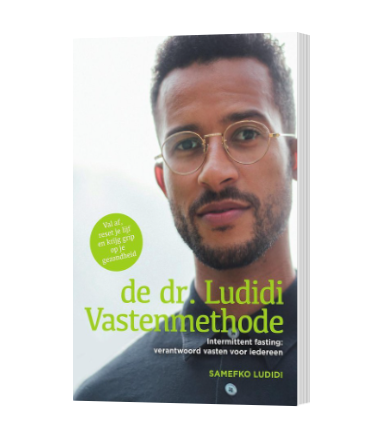
Dr. Ludidi, Samefko Ludidi, is a graduated nutrition scientist (who is not a member of the Nederlandse Academie voor Voedingswetenschappen, the national academy of nutrition science) and has had a practice for years where he coaches people. But he is also often asked to give lectures, because he is known for his expertise in translating science into practice. He is also a university guest lecturer.
Getting to know his work
My first encounter with the knowledge and claims of Dr. Ludidi was his visit to the podcast of Arie Boomsma, ‘Een serie over voeding’ (A series about nutrition). He made many strong claims about intermittent fasting: good for weight loss, good against chronic diseases and good for cell rejuvenation (autophagy). Unfortunately, no evidence was cited, but my interest was definitely piqued.
In the end I made a story on Instagram (I had 50 followers at the time) in which I said that I was going to dive into Ludidi's scientific support. I tagged him, hoping to get more evidence. I also tagged him in a story together with a scientific study that contradicted his claims. However, I got no response.
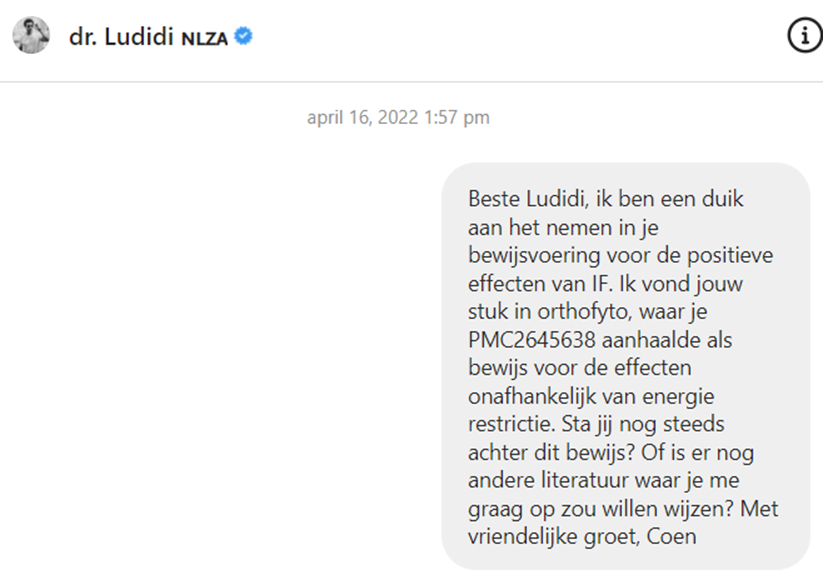
So I went looking for his evidence on the internet. His website is full of blogs, but unfortunately I found no references there either. Eventually I ended up at a piece by him in OrthoFyto, a trade journal for paramedics in functional medicine. I took a small dive into his scientific support and soon found that his interpretations were not correct. I sent him a message on Instagram, but unfortunately got no response.
I made a story with my findings and tagged Ludidi in it. Again I got no response on the content. So I decided to buy his book to take a deeper dive into his support. Here are my findings.
Update: After sharing my dive and repeatedly approaching and tagging Ludidi, I was blocked in 2022. In 2025 my blog was brought to his attention again and he put an invitation to have a cup of coffee in his story. I accepted it on the condition that we would discuss my criticism of the content. You can hear more about this in the podcast. Before this meeting took place (and while we were still in talks about it), Ludidi decided to join the podcast "kennis is kracht podcast" as a guest. There they discussed my way of giving criticism. I thought the picture that was painted, "Coen doesn't want to talk, he just starts throwing mud right away", was unfair. They also did not discuss my criticism of the content, which I find very strange. I put my thoughts about this online in stories on instagram. The men did not agree with this and thought it was too aggressive, and Ludidi decided he no longer wanted to talk with me. He also said he never had the intention of discussing my criticism of the content. A sad situation.
Orthofyto
Let's start with the piece in OrthoFyto: ‘Intermittent fasting tegen zwaarlijvigheid’ (Intermittent fasting against obesity). This gave me a first look into Ludidi's scientific kitchen.
Ludidi reasons that a surplus of energy is the basis of overweight. However, he is not a fan of the traditional low-energy diet, because according to him it leads to long-term under-eating and with it a slowing of the metabolism.
According to him, intermittent fasting is therefore the answer to our problem of diseases of affluence and overweight. Intermittent fasting would namely lead to increased fat burning, independent of an energy restriction.
“Intermittent fasting leads to mitochondrial biogenesis, therefore increases fat metabolism and can thus play a role in reducing body fat and consequently overweight. By extension, intermittent fasting can have a positive effect on the development of diseases of affluence such as cardiovascular disease, type 2 diabetes and possibly also alzheimer's (13). Effects of IF occur independently of energy restriction (14), although energy restriction is often an accompanying consequence.” (translated from Dutch)
Ludidi presents it as if it is a done deal. As if it is all hard scientifically proven. But is that so?
The evidence
No, it is not.
If you read this narrative review carefully, there are indeed studies in mice/rats that have shown that IF, independent of energy restriction, can have positive effects on health. But in most studies an IF regimen directly causes an energy deficit. This makes it hard to attribute the positive effects to IF.
“For example, when Sprague–Dawley rats are maintained on a every-other-day fasting IF diet, they consume approximately 30% less food over time and maintain body weights 10–15% below that of rats fed ad libitum [7]. On the other hand, C57BL/6 mice maintained on the same IF regimen consume only 5% less food over time compared with mice fed ad libitum and maintain a body weight similar to that of mice fed ad libitum [6]. Although C57BL/6 mice on the IF diet were not calorie restricted, the diet resulted in beneficial physiological changes that were as great or greater than those in mice maintained on a 40% CR diet.”
An even bigger problem is that these results have not yet been confirmed by research in humans. Research in animals certainly has its place in building the evidence for a claim. It can uncover mechanisms or allow us to carry out experiments that we cannot carry out on humans (to see whether it is safe). Still, we will have to confirm results from animal studies in humans, certainly when it has been shown that there are no negative consequences (as with fasting). This is also why the authors of the study conclude that a lot is still unclear about IF in humans and that well-controlled studies are needed.
“Clearly, well-controlled human studies are required to establish the health benefits that can be achieved by CR and IF in humans across a range of body mass indexes.”
Ludidi is (I think) of the opinion that source 14 is such a well-controlled study, one that shows that IF has positive effects on our health independent of an energy restriction.
In the study by Stote, 15 people were randomly placed in two groups: three meals per day (3-meal group) or one meal per day (1-meal group). To be clear: this is not about a fasting method that matches the Dr. Ludidi method (which is three meals between 12:00 and 20:00).
After 8 weeks there was a break of 11 weeks, after which the people switched groups to follow the guidelines again for another 8 weeks. The people in the 3-meal group ate on average 2,429 kcal, while the 1-meal group ate on average 2,364 kcal. Even though the focus was on an energy balance, the people in the 1-meal group did eat less energy. Which is not strange, since everything had to be crammed into one meal (with an eating window of 4 hours).
After the two periods of eight weeks, the people in the 1-meal group weighed significantly less (65.9 vs. 67.3 kg) than in the 3-meal group. But here comes the crux: in neither group was there a significant difference in body weight between the start and the end of the study. In other words, after eight weeks neither protocol showed a change in weight, fat mass or fat-free mass.
“Even with an 11-wk washout period between the 2 diet protocols, no significant differences from baseline were seen in body weight, fat mass, fat-free mass, or total body water in either period of the study.”
In addition, the 1-meal group seemed to have worse cholesterol and blood pressure values. So this study is far from conclusive evidence that the effects of IF occur independent of energy restriction. Still, Ludidi cites this study as if he is citing strong scientific evidence. No ‘maybe’, ‘could’ or ‘possibly’.
The book
I repeatedly tagged Ludidi with my findings in my stories on Instagram, but unfortunately got no response on the content.
I am going to highlight a few claims he makes and will briefly go into the support he gives for these claims. It was not necessary for me to take a very deep dive, because it quickly became clear that there was quite a lot wrong with Ludidi's interpretations.
Claim: Experimental studies show that extended periods of not eating make your brain sharp and can help reduce the risk of brain diseases such as Alzheimer's.
Source: Mattson, MP., Longo, VD & Harvie, M. Impact of intermittent fasting on health and disease processes.(2016)
Ludidi cites a narrative review as evidence for the effect of fasting on our brain and with it on brain diseases. This review is divided into two parts: research in animals and research in humans. The first thing I notice is that the study contains no chapter on research in humans that relates to the brain or neurological diseases.
The authors conclude that evidence has indeed been found in animals that IF has an effect on our brain and can help against diseases such as Alzheimer's. In the chapter in question, however, the discussion is mainly about ADF (alternate day fasting), that is: not eating at all every other day—a very different form of fasting from what Ludidi is talking about. The research has also all been carried out in animals, so we do not know how this translates to humans. The authors also state that experimental research in humans is needed. Ludidi, on the other hand, claims that experimental research has already been done.
Study: “IF can delay onset and slow the progression of neuronal dysfunction and degeneration in animal models of Alzheimer’s, Parkinson’s and Huntington’s diseases… Randomized controlled clinical trials of IF versus PF and isoenergetic continuous energy restriction in human subjects will be required to establish the efficacy of IF in improving general health, and preventing and managing major diseases of aging.”
Claim: Research has shown that interrupted fasting is an effective method to lose weight without it costing you muscle mass. This is the case with many diets that hammer on eating less.
Ludidi tries to make a case for IF as an effective method to lose weight and keep muscle mass. He bases this on two studies:
Source: Wilsen, JM. Et al. Effects of Ketogenic Dieting on Body Composition, Strength, Power, and Hormonal Profiles in Resistance Training Men. (2020)
The review by Varady describes studies that compare IF in combination with an energy deficit to an energy deficit alone. Ludidi's claim immediately feels misleading, because he (elsewhere in the book and in the OrthoFyto piece) makes it look as if IF leads to weight loss independent of an energy deficit. On the basis of Varady's review, however, you cannot say that at all, because Varady specifically studied IF in combination with an energy deficit. So people had to eat less often and less energy in total.
In addition, the review by Varady cites no studies that investigated the 16/8 method (fasting 16 hours a day), which is exactly the core of the Dr. Ludidi Vastenmethode. In this review too, it is often about the alternate day fasting (ADF) method.
Later in his book Ludidi mentions the study by Stote (which I discussed earlier), about which he says:
“It may happen that people who fast also eat somewhat less in the longer term than people who do not fast. This is certainly not the only reason why interrupted fasting works so well. There is by now already sufficient convincing evidence that even when you do not eat less on balance, interrupted fasting can still bring health gains.” (translated from Dutch)
But the ‘convincing evidence that even when you do not eat less on balance, interrupted fasting can still bring health gains’ simply does not exist.
Varady does show an interesting result: less loss of muscle mass with fasting in combination with an energy deficit. But there is certainly no question of no loss of muscle mass. Participants still lost on average 10% of the weight loss as muscle mass, against 25% in people who did not follow an IF protocol. Losing weight without it costing muscle mass is therefore not the case.
“From the studies reviewed here, it would appear as though a lower proportion of lean mass is lost in response to intermittent calorie restriction (90% weight lost as fat, 10% weight lost as fat-free mass) when compared to daily calorie restriction (75% weight lost as fat, 25% weight lost as fat-free mass).”
Finally, Ludidi also cites the study by Wilsen as a source. Very strange, since this study actually shows that a ‘traditional western diet’, high in carbohydrates and low in calories (that is, a diet aimed at eating less), shows an increase in muscle mass during weight loss. This makes me lose the thread a little.
Wilsen Study: “This study investigated the impact of an isocaloric and isonitrogenous ketogenic diet (KD) versus a traditional western diet (WD) on changes in body composition… Lean body mass (LBM) increased in both the KD and WD groups (2.4% and 4.4%, p < 0.01) at week 10. However, only the KD group showed an increase in LBM between weeks 10 and 11 (4.8%, p < 0.0001). Finally, fat mass decreased in both the KD (−2.2 ± 1.2 kg) and WD groups (−1.5 ± 1.6 kg).”
Conclusion
These are a few examples that I came across in Ludidi's book. There are more, but my point is clear. It feels as if Ludidi started from his conviction:
“For years I have used fasting to help my clients improve their health.” (translated from Dutch)
“I know it works. Not least because its effect on health has been scientifically proven. Through my years of practical experience…” (translated from Dutch)
And then went looking for studies with conclusions that somewhat fit his convictions, although that is not always the case either. I am afraid that Ludidi has committed himself to his hypothesis: ‘Fasting, independent of an energy restriction, has many health benefits.’ When you commit yourself to an idea or a theory like that and even put your name on it, it becomes hard to stay objective. Let alone to be open to criticism of the content. Very human.
Let me be clear: as far as I am concerned, science is not the holy grail. If Ludidi had limited himself to his practical experience and had made very careful claims based on studies in animals, I would not have had a problem with that. However, there are now firm claims based on studies in animals or narrative reviews that do not support the claim, or based on studies that have been misinterpreted. Finally, the cited studies also use fasting methods that are very different from Ludidi's. I do not think you can lump all fasting methods together.
We are by now a few years further on, and there has certainly been promising research into intermittent fasting. It is important, however, that we do not draw exaggerated and hasty conclusions. There are still big differences in the fasting methods used in scientific research. I see promising results from research into early fasting (from 8:00 to 15:00), which I wrote about earlier in my piece on the book Ingelepeld by prof. Spector. This is at odds with the method Ludidi follows: fasting from 12:00 to 20:00.
It is not yet clear what effect intermittent fasting has on our health exactly, although science has shown that it is a safe and effective way to limit your energy intake—which can bring weight loss and considerable health gains. There is, however, still a lot of uncertainty about which form of intermittent fasting is optimal and what effects it has on people's health. This book has in any case not taken that uncertainty away.
What did you think? Let me know in the form of a comment or an email: [email protected]
Have you come across a claim on the internet or social media and are you curious about an assessment of its support? Let me know and I will dive in!
Do you want to support me and my nutrition science adventure? Share my articles or the podcast on your socials!
Everything you read on this website is my opinion, based on knowledge and experience. There is a good chance that I sometimes overlook something, or that something could be better. I would love to hear it! We do science together.
Follow me or connect with me on:
Instagram: https://www.instagram.com/coenfirmation_bias/
Linkedin: https://www.linkedin.com/in/coen-dros/